Tools Reference
This comprehensive reference covers all 40 tools available in the WhoisXML API MCP Server.

Overview
The WhoisXML API MCP Server provides 31 single-input API tools and 7 bulk variants (plus 2 polling helpers) for querying various types of domain, IP, and DNS information and the account's own credits (account_balance), plus a built-in tool_search utility for dynamic tool discovery. Each API tool is designed to interact with specific WhoisXMLAPI endpoints and provides structured data responses.
The hosted endpoint (mcp-hosted.whoisxmlapi.com) serves the 40 API tools; tool_search is stdio-only, enabled by the --defer-loading flag.
Tools List
whois- Domain WHOIS informationcategorization- Domain categorizationemail_verification- Email verificationreverse_ip- Reverse IP lookupreverse_mx- Reverse MX lookupreverse_ns- Reverse NS lookupreverse_dns- Reverse DNS lookupreverse_whois- Reverse WHOIS lookupreverse_whois_advanced- Advanced Reverse WHOIS lookupregistrant_alert- Registrant-based domain monitoringbrand_alert- Brand-term domain detectiondisposable_email_check- Disposable email detectionwhois_history- WHOIS historysubdomain_lookup- Subdomain lookupdomain_and_subdomain_discovery- Domain and subdomain discoverydns_lookup- DNS lookupdns_history- DNS historyipgeolocation- IP geolocationip_netblocks- IP netblocksssl_certificates- SSL certificatesthreat_intelligence- Threat intelligencedomain_info- Domain infotyposquatting- Typosquatting group detection (Bulk Registration Risk API)domain_reputation- Domain reputation scoringwebsite_screenshot- Website screenshot capturevpn_proxy_detection- VPN, proxy and Tor detection for an IPdomain_availability- Whether a domain name is registered or free to registeraccount_balance- Credits left on each product (spends no credits)domain_profile- One-call profile of a domain, in partsinfrastructure_pivot- From one domain to the infrastructure behind it and the other domains that share itlookalike_triage- Look-alike domains of one brand: search, rank, set aside, check the top suspectstool_search- Dynamic tool discovery (enabled with--defer-loading)
Bulk tools
bulk_whois- Bulk WHOIS lookup (up to 10,000 domains)bulk_dns_lookup- Bulk DNS lookup (up to 200 domains)bulk_ip_geolocation- Bulk IP geolocation (up to 200 IPs)bulk_email_verification- Bulk email verification (up to 10,000 emails)bulk_subdomain_lookup- Bulk subdomain lookup (up to 200 domains)bulk_vpn_proxy_detection- Bulk VPN, proxy and Tor detection (up to 100 IPs)bulk_domain_availability- Bulk domain availability (up to 200 domains)bulk_job_status- Poll progress of a native bulk jobbulk_job_results- Fetch results of a completed native bulk job
What each tool costs
Each WhoisXML API product has its own credit balance, and a tool spends only the balance of its product; account_balance shows what each balance has left. "Up to" is the most one call can cost. A call estimated at more than the spend cap runs only with confirm: true.
| Tool | Cost | Credit balance |
|---|---|---|
account_balance | Free | None |
brand_alert | Free for a preview, 10 credits for a purchase, 300 credits for a purchase with with_typos: true; the cost of a preview with with_typos: true is not yet confirmed | Domain Research Suite |
bulk_dns_lookup | 1 credit per entry of domain_names, up to 200 entries per call | DNS Lookup API |
bulk_domain_availability | 1 credit per entry of domain_names, up to 200 entries per call | Domain Availability API |
bulk_email_verification | 1 credit per entry of emails, up to 10,000 entries per call | Email Verification API |
bulk_ip_geolocation | 1 credit per entry of ip_addresses, up to 200 entries per call | IP Geolocation API |
bulk_job_results | Free | None |
bulk_job_status | Free | None |
bulk_subdomain_lookup | 10 credits per entry of domain_names, up to 200 entries per call | Domain Research Suite |
bulk_vpn_proxy_detection | 1 credit per distinct entry of ip_addresses (a repeated entry counts once), up to 100 distinct entries per call | VPN & Proxy Detection API |
bulk_whois | 1 credit per entry of domains, up to 10,000 entries per call | WHOIS API |
categorization | Up to 1 credit per call | Website Categorization API |
disposable_email_check | Up to 1 credit per call | Email Verification API |
dns_history | 5 credits per request; one request per call unless pages asks for more, up to 100 credits per call | Domain Research Suite |
dns_lookup | Up to 2 credits per call | DNS Lookup API |
domain_and_subdomain_discovery | Up to 11 credits per call | Domain Research Suite |
domain_availability | Up to 1 credit per call | Domain Availability API |
domain_info | Up to 5 credits per call | Domain Research Suite |
domain_profile | Up to 11 credits per call; the cost of a call with sections: ["certificate", ...] is not yet confirmed | Several, named in each answer |
domain_reputation | Up to 3 credits per call | Domain Reputation API |
email_verification | Not yet confirmed | Email Verification API |
infrastructure_pivot | Up to 25 credits per call | Several, named in each answer |
ip_netblocks | Not yet confirmed | IP Netblocks API |
ipgeolocation | Up to 1 credit per call | IP Geolocation API |
lookalike_triage | Up to 88 credits per call; the cost of a call with sections: ["certificate", ...] is not yet confirmed | Several, named in each answer |
registrant_alert | Up to 10 credits per call; the cost of a call with with_typos: true is not yet confirmed | Domain Research Suite |
reverse_dns | Up to 7 credits per call | Domain Research Suite |
reverse_ip | Up to 7 credits per call | Domain Research Suite |
reverse_mx | Up to 7 credits per call | Domain Research Suite |
reverse_ns | Up to 7 credits per call | Domain Research Suite |
reverse_whois | Up to 1 credit per call | Domain Research Suite |
reverse_whois_advanced | Up to 1 credit per call | Domain Research Suite |
ssl_certificates | Not yet confirmed | SSL Certificates API |
subdomain_lookup | Up to 10 credits per call | Domain Research Suite |
threat_intelligence | Up to 100 credits per call | Threat Intelligence API |
tool_search | Free | None |
typosquatting | Up to 5 credits per call | Domain Research Suite |
vpn_proxy_detection | Up to 1 credit per call | VPN & Proxy Detection API |
website_screenshot | Up to 1 credit per call; the cost of a call with full_page: true or type: "pdf" is not yet confirmed | Website Screenshot API |
whois | Up to 5 credits per call | WHOIS API |
whois_history | Up to 50 credits per call | Domain Research Suite |
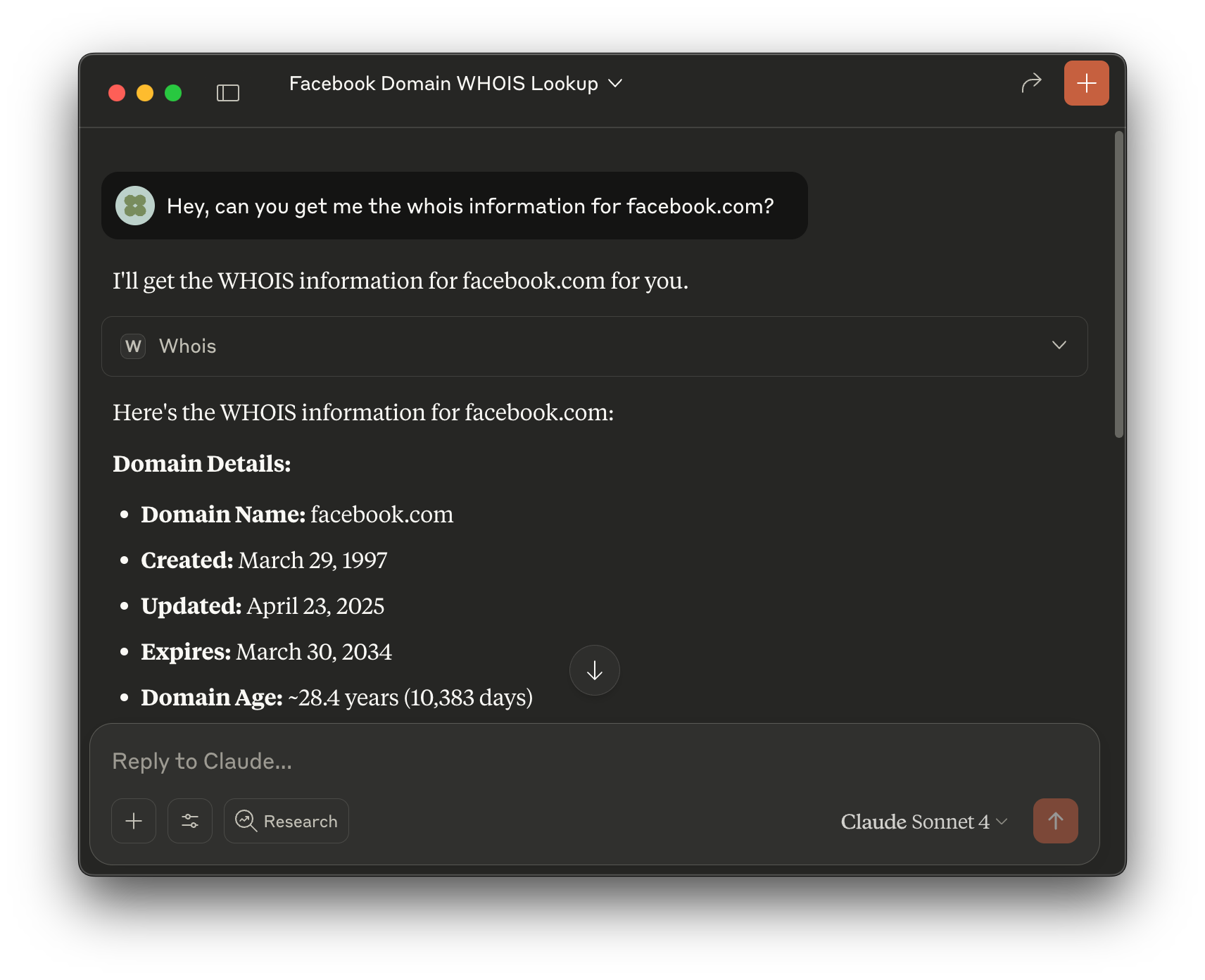
whois
Description: Get WHOIS information for a domain including registration dates, status, nameservers, and contact info.
Arguments
domain(string, required) - Domain name to queryquery_type(string, optional) - Query type: "auto", "whois", or "rdap". "rdap" is only supported in domain queries but might not be available for all domains. "auto" will always choose correctly Default: "auto" Allowed values: "auto", "whois", "rdap"prefer_refresh_even_if_incomplete(boolean, optional) - If true, provides most up-to-date but potentially incomplete dataforce_refresh(boolean, optional) - If true, forces hard refresh. Costs 5 API callsinclude_domain_availability(boolean, optional) - If true, includes domain availability statusinclude_ip_for_domain_queried(boolean, optional) - If true, includes hosting IP address for the domainget_host_ip_whois_on_no_domain_data(boolean, optional) - If true, returns host IP WHOIS when domain WHOIS is unavailableget_registrar_proxy_data(boolean, optional) - If true, includes registrar WHOIS proxy info in "privateWhoisProxy"fetch_whois_from_registry_only(boolean, optional) - If true, returns only registry WHOIS data, not registrar dataremove_raw_text(boolean, optional) - If true (the default), removes raw text from WHOIS output Default: trueparse_registry_raw_text(boolean, optional) - If true, provides parsed format for registry informationparse_registrar_raw_text(boolean, optional) - If true, provides parsed format for registrar information
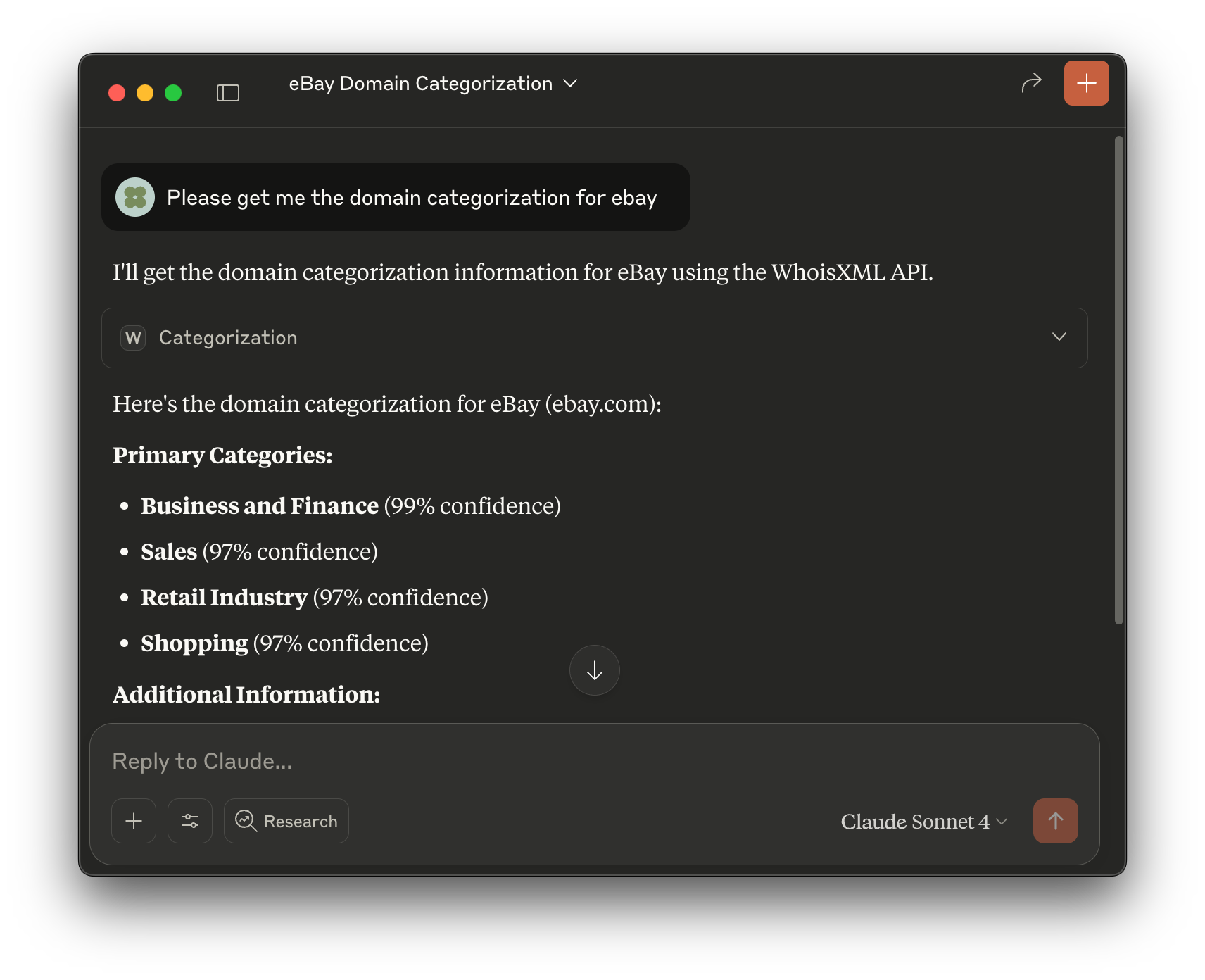
categorization
Description: Classify a domain into IAB Content Taxonomy v3.1 content categories (Website Categorization v4).
Arguments
domain(string, required) - Domain name to categorize (e.g., 'example.com')url(string, optional) - Full URL to classify (optional). Defaults upstream to https://{domain}; set it to categorize a specific page rather than the domain root
Response
Returns 1-3 ranked categories plus a primary_category shortcut. Each category carries a string ID (e.g. "IAB-596"), a hierarchical path ("Shopping > Online Marketplace") with tier1..tier4 levels, and a confidence score. Response metadata: taxonomy_version, credits_charged, latency_ms, model, an abstain object (flags parked/dead/thin sites with no real business purpose), a source object (is_historical_fallback marks results served from historical data when the live crawl was blocked), and error.
Compared to the legacy v3 backend, the response no longer includes ASN data (as), createdDate, or websiteResponded — use ip_netblocks / whois for infrastructure and registration facts.
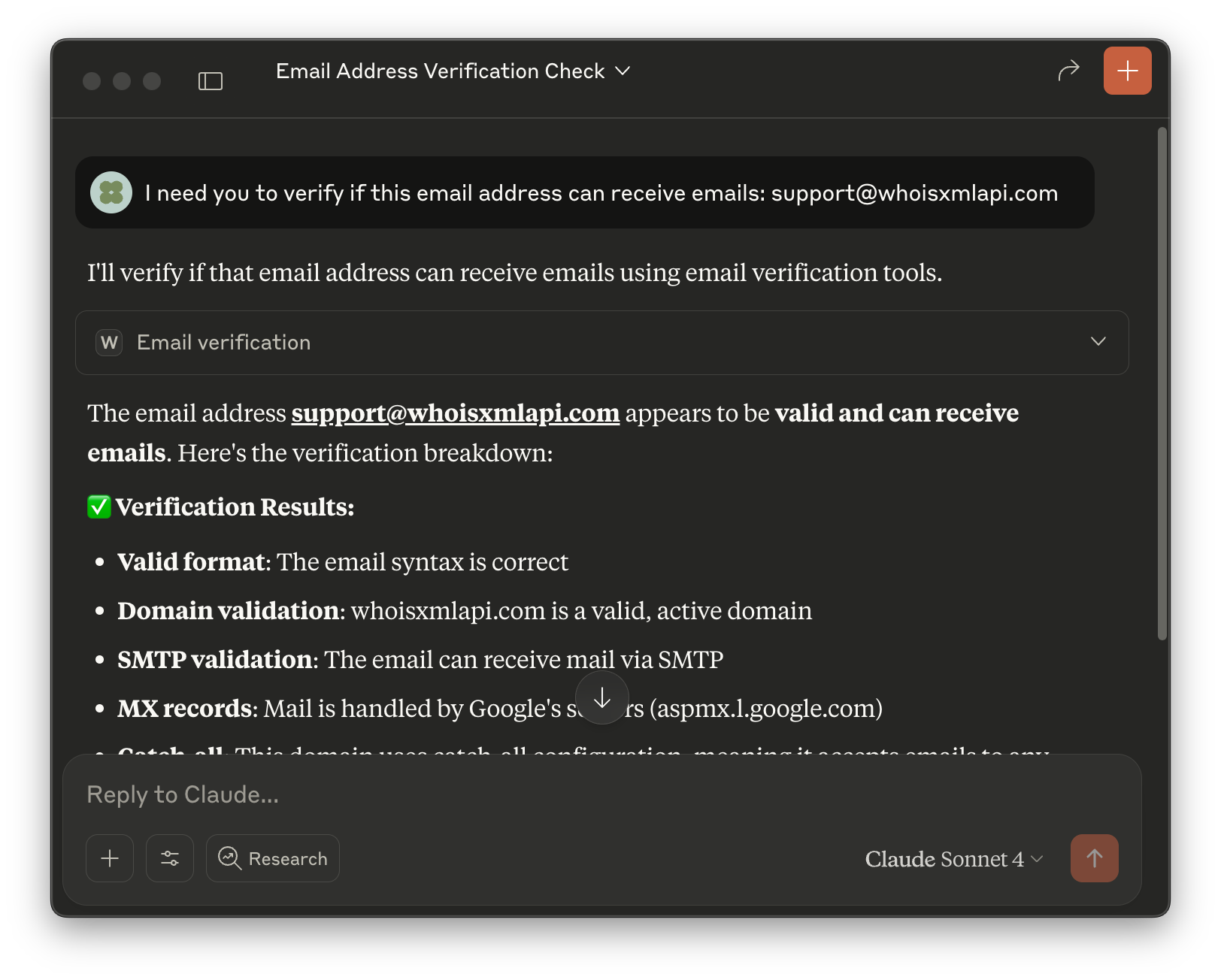
email_verification
Description: Verify if an email address is legitimate. Checks syntax, SMTP, DNS, free/disposable status, and catch-all configuration.
Arguments
email(string, required) - Email address to verifyvalidate_using_dns(boolean, optional) - Validate using DNS records Default: truevalidate_using_smtp(boolean, optional) - Validate using SMTP Default: truecheck_if_email_is_catch_all(boolean, optional) - Check if email is catch-all Default: truecheck_if_email_is_free(boolean, optional) - Check if email is free Default: truecheck_if_email_is_disposable(boolean, optional) - Check if email is disposable Default: true
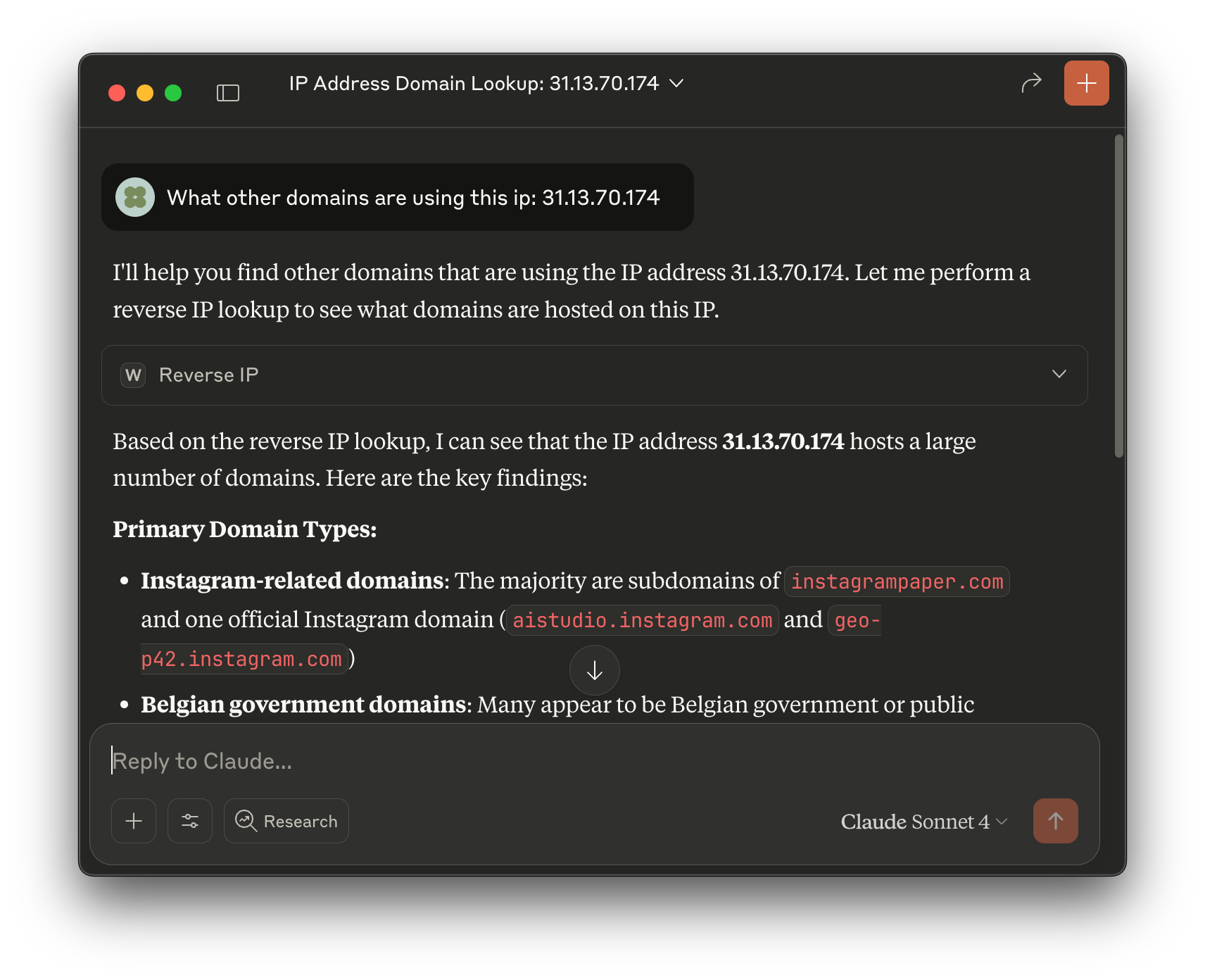
reverse_ip
Description: Find all domains sharing the same IP address and connection dates.
Arguments
ipv4_address(string, required) - IPv4 address to searchfrom_needle(string, optional) - Pagination needle from previous response. Max 300 records per pageinclude_additional_checks(boolean, optional) - If true, performs additional DNS checks (wildcard, domain activeness). Slower but more detailedpreview(boolean, optional) - If true, returns just the domain names without additional information Default: false
reverse_mx
Description: Find all services sharing the same MX server and connection dates.
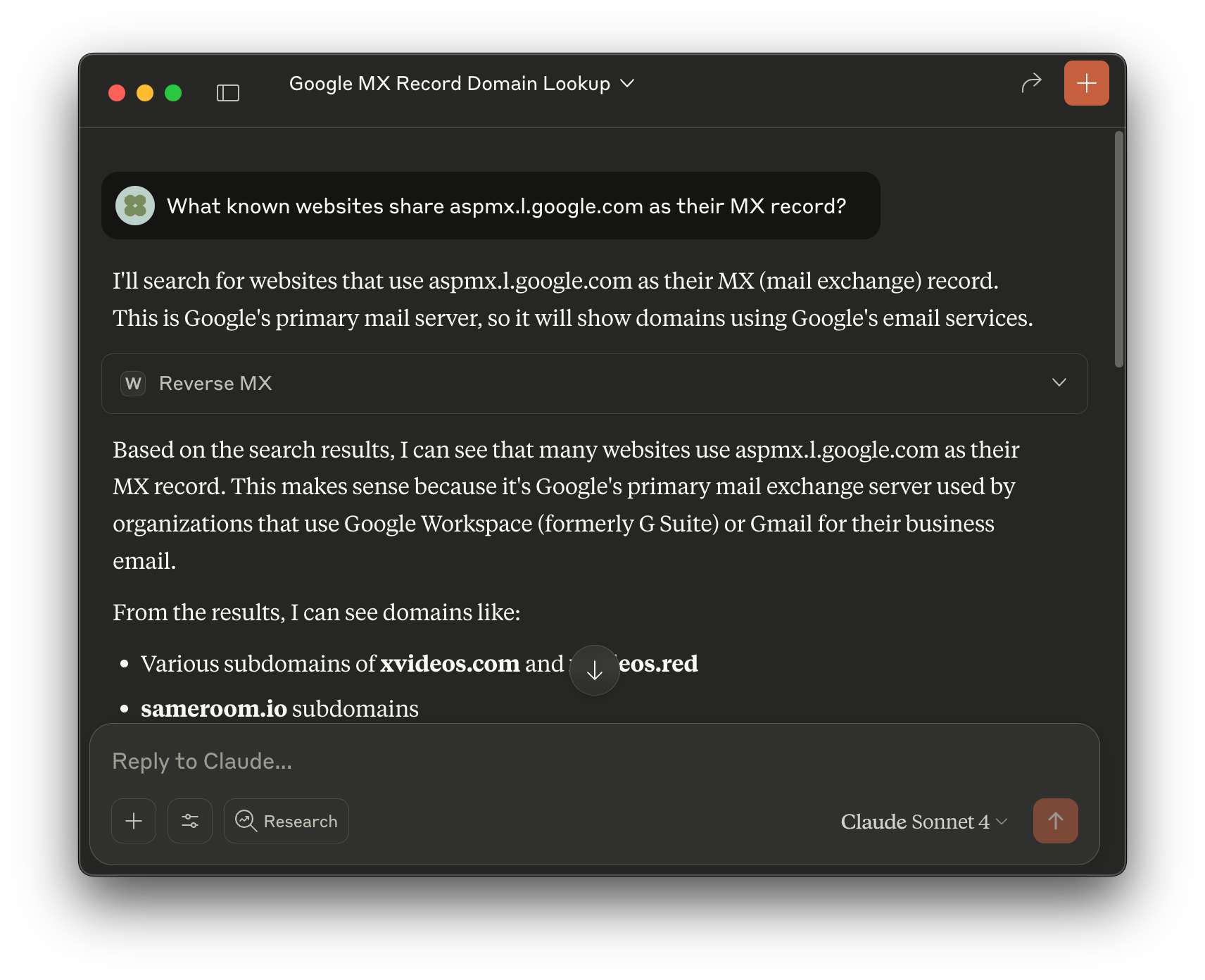
Arguments
mx_hostname(string, required) - MX hostname to searchfrom_needle(string, optional) - Pagination needle from previous response. Max 300 records per pageinclude_additional_checks(boolean, optional) - If true, performs wildcard and domain activeness checks. Extra costpreview(boolean, optional) - If true, returns just the domain names without additional information Default: false
reverse_ns
Description: Find all services sharing the same NS nameserver and connection dates.
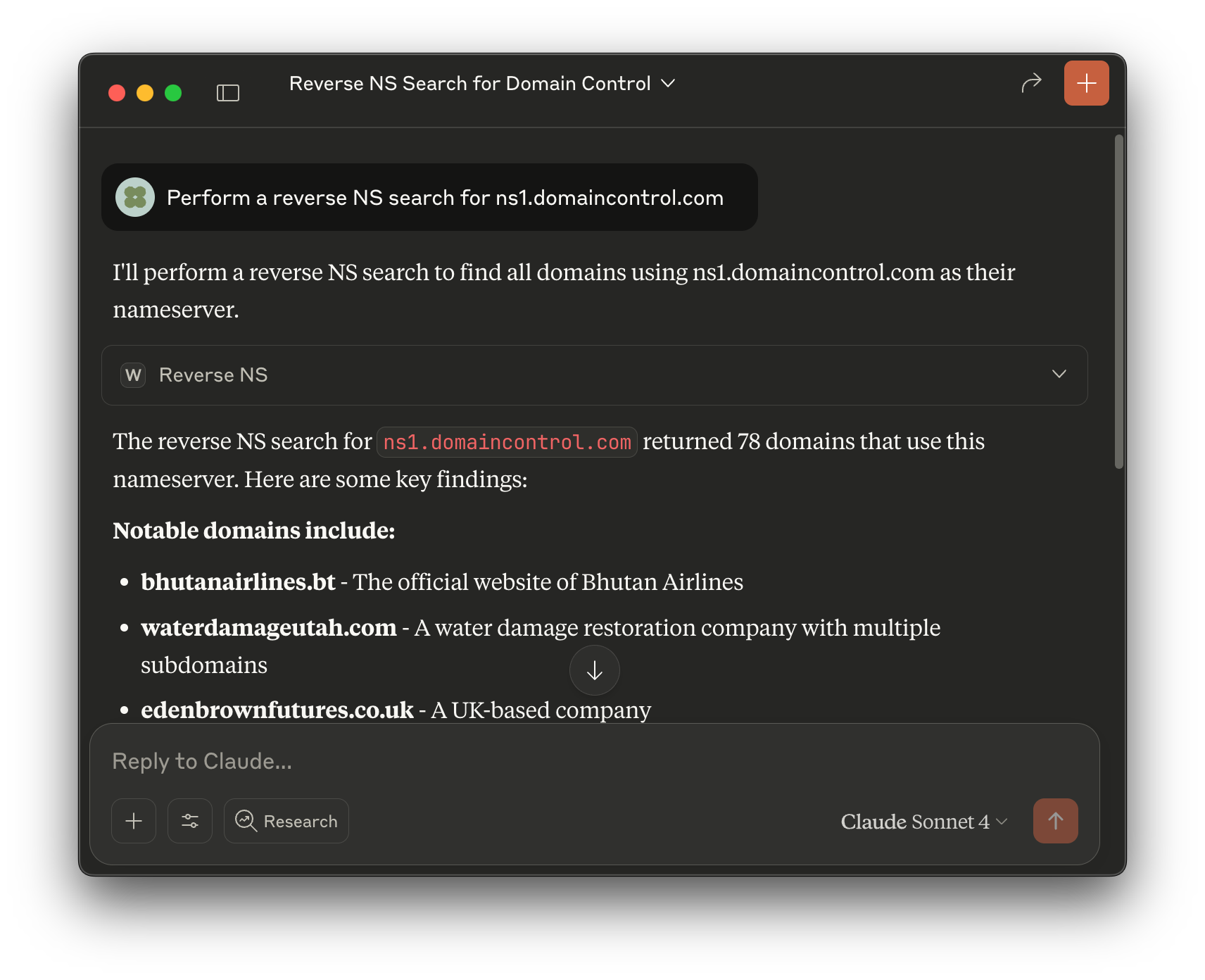
Arguments
ns_hostname(string, required) - NS nameserver hostname to searchfrom_needle(string, optional) - Pagination needle from previous response. Max 300 records per pageinclude_additional_checks(boolean, optional) - If true, performs wildcard and domain activeness checks. Extra costpreview(boolean, optional) - If true, returns just the domain names without additional information Default: false
reverse_dns
Description: Find DNS records matching search criteria. Returns domains and DNS record values. Must use wildcards in the "term" field for partial matches otherwise the search will be exact.
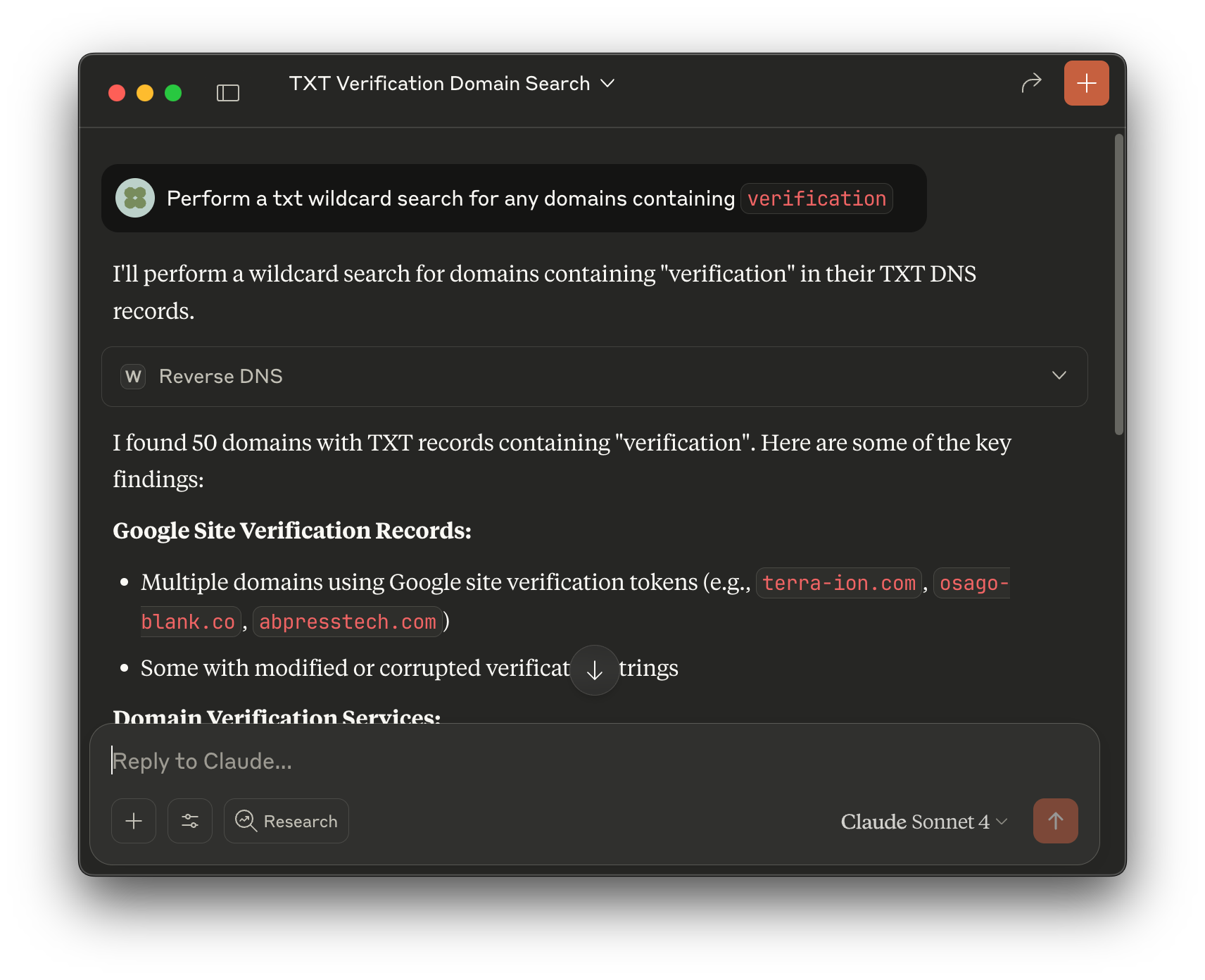
Arguments
record_type(string, required) - DNS record type: "soa", "txt", or "cname" Allowed values: "soa", "txt", "cname", "SOA", "TXT", "CNAME"terms(array of objects, required) - Search terms array defining what to search for in DNS records (combined with AND logic). Must use wildcards for partial matches otherwise the search will be exactfield(string, required) - Field to search: "domain" or "value" Allowed values: "domain", "value"term(string, required) - Search keyword. Supports wildcardsexclude(boolean, optional) - If true, excludes matching records from results Default: false
limit(number, optional) - Maximum records to return. Recommended to start with 10 and increase if needed. Max: 1000 Default: 10 Range: 1-1000include_additional_checks(boolean, optional) - If true, performs wildcard and domain activeness checks. Extra cost Default: falsepreview(boolean, optional) - If true, returns just the domain names without additional information Default: false
reverse_whois
Description: Find domains containing specific search terms in their whois records.
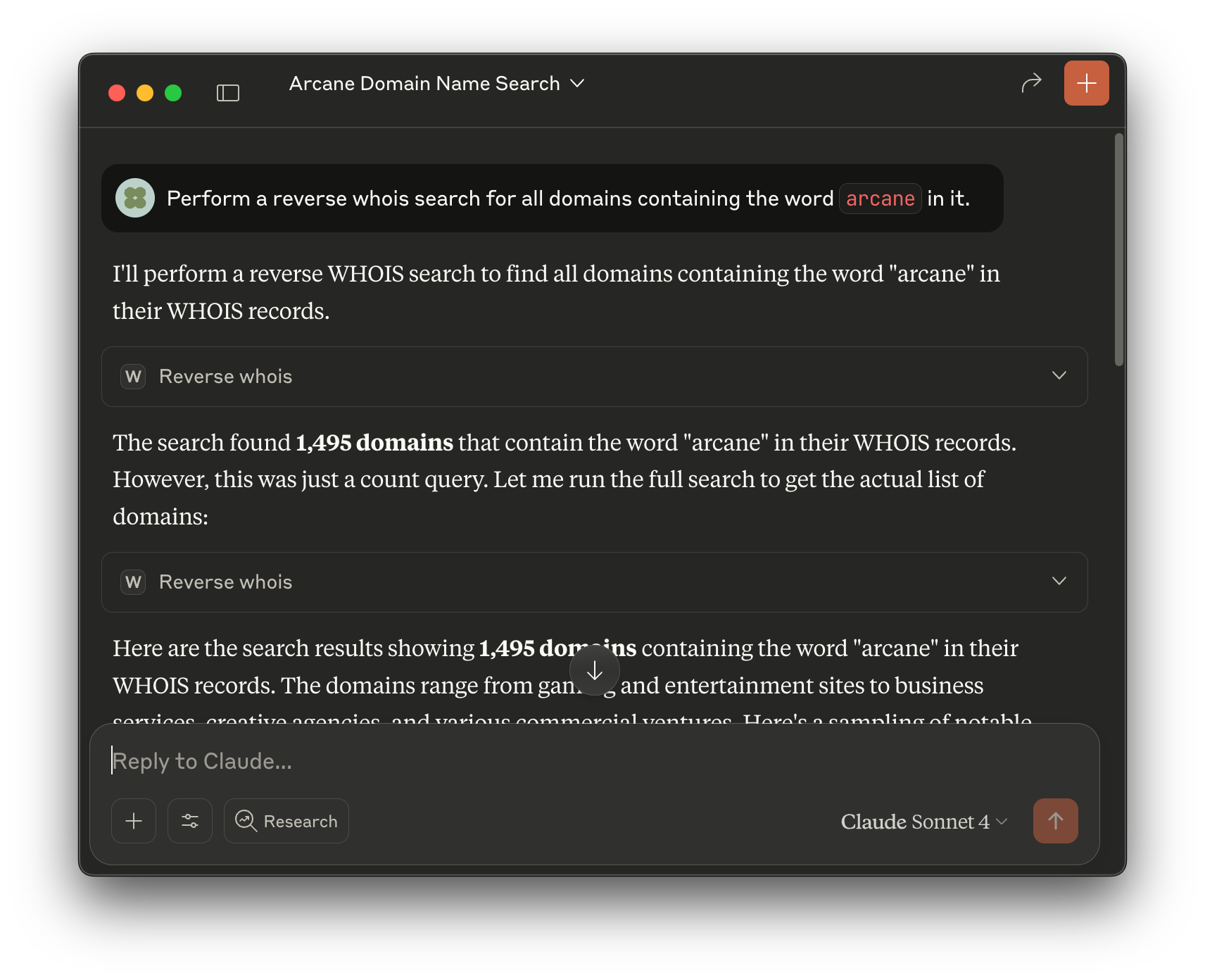
Arguments
included_search_terms(string, required) - Comma-separated search terms to include (combined with AND logic). Max 4 items. Case insensitiveexcluded_search_terms(string, optional) - Comma-separated search terms to exclude. Max 4 items. Case insensitivesearch_type(string, optional) - Search type: "current" or "historic". "current" searches current records, "historic" searches all recordscount_only(boolean, optional) - If true, returns only count (no credit usage). If false, returns domain list Default: truepunycode(boolean, optional) - If true, encodes domain names to Punycodeinclude_audit_dates(boolean, optional) - If true, includes domain list and last audit date Default: falsecreated_date_from(string, optional) - Search domains created after this date. Format: YYYY-MM-DDcreated_date_to(string, optional) - Search domains created before this date. Format: YYYY-MM-DDupdated_date_from(string, optional) - Search domains updated after this date. Format: YYYY-MM-DDupdated_date_to(string, optional) - Search domains updated before this date. Format: YYYY-MM-DDsearch_after(string, optional) - Pagination needle from previous page's "nextPageSearchAfter" value
reverse_whois_advanced
Description: Find domains using advanced field-specific search on WHOIS records. Each search term targets a specific WHOIS field with optional exact match and exclude flags. Up to 4 search terms combined with AND logic.
Arguments
search_terms(array of objects, required) - Field-specific WHOIS search term objects (max 4), combined with AND. Each object has "field" (required) and "term" (required), plus optional "exclude" and "exact_match" booleans. A JSON-encoded string of the same array is also accepted for backward compatibilityfield(string, required) - WHOIS field to search, e.g. DomainName, RegistrarName, NameServers, Email, RegistrantContact.Organization Allowed values: "DomainName", "RegistrarName", "NameServers", "Email", "WhoisServer", "Status", "RegistrantContact.City", "RegistrantContact.Country", "RegistrantContact.Email", "RegistrantContact.Fax", "RegistrantContact.FaxExtension", "RegistrantContact.Name", "RegistrantContact.Organization", "RegistrantContact.PostalCode", "RegistrantContact.State", "RegistrantContact.StreetAddress", "RegistrantContact.Telephone", "RegistrantContact.TelephoneExtension", "AdminContact.City", "AdminContact.Country", "AdminContact.Email", "AdminContact.Fax", "AdminContact.FaxExtension", "AdminContact.Name", "AdminContact.Organization", "AdminContact.PostalCode", "AdminContact.State", "AdminContact.StreetAddress", "AdminContact.Telephone", "AdminContact.TelephoneExtension", "BillingContact.City", "BillingContact.Country", "BillingContact.Email", "BillingContact.Fax", "BillingContact.FaxExtension", "BillingContact.Name", "BillingContact.Organization", "BillingContact.PostalCode", "BillingContact.State", "BillingContact.StreetAddress", "BillingContact.Telephone", "BillingContact.TelephoneExtension", "TechContact.City", "TechContact.Country", "TechContact.Email", "TechContact.Fax", "TechContact.FaxExtension", "TechContact.Name", "TechContact.Organization", "TechContact.PostalCode", "TechContact.State", "TechContact.StreetAddress", "TechContact.Telephone", "TechContact.TelephoneExtension"term(string, required) - Search string. Case insensitive, supports wildcardsexact_match(boolean, optional) - If true, exact field match instead of substring Default: falseexclude(boolean, optional) - If true, exclude matching records from results Default: false
search_type(string, optional) - Search type: "current" or "historic". "current" searches current records, "historic" searches all recordscount_only(boolean, optional) - If true, returns only count (no credit usage). If false, returns domain list Default: truepunycode(boolean, optional) - If true, encodes domain names to Punycodeinclude_audit_dates(boolean, optional) - If true, includes domain list and last audit date Default: falsecreated_date_from(string, optional) - Search domains created after this date. Format: YYYY-MM-DDcreated_date_to(string, optional) - Search domains created before this date. Format: YYYY-MM-DDupdated_date_from(string, optional) - Search domains updated after this date. Format: YYYY-MM-DDupdated_date_to(string, optional) - Search domains updated before this date. Format: YYYY-MM-DDsearch_after(string, optional) - Pagination needle from previous page's "nextPageSearchAfter" valueexpired_date_from(string, optional) - Search domains that expired after this date. Format: YYYY-MM-DDexpired_date_to(string, optional) - Search domains that expired before this date. Format: YYYY-MM-DD
Example
Search for domains registered by "Airbnb, Inc." outside the United States:
{
  "search_terms": "[{\"field\":\"RegistrantContact.Organization\",\"term\":\"Airbnb, Inc.\",\"exact_match\":true},{\"field\":\"RegistrantContact.Country\",\"term\":\"UNITED STATES\",\"exclude\":true}]"
}
registrant_alert
Description: Find newly added, dropped, or updated domains whose WHOIS records match search terms in registrant contact fields (email, name, organisation, etc.). Use this for brand-impersonation monitoring and threat-actor infrastructure tracking. Do NOT use this for general WHOIS-text matching (use reverse_whois) or for domain-name string matching.
Arguments
included_search_terms(string, required) - Comma-separated terms to include (AND logic). Max 4 items. Case insensitive. Wildcards * supportedexcluded_search_terms(string, optional) - Comma-separated terms to exclude. Max 4 itemsdate(string, optional) - Date to query in YYYY-MM-DD format. When omitted, the upstream API uses its own default (typically yesterday)mode(string, required) - 'preview' returns count only (no credits used). 'purchase' returns the full domain list Allowed values: "preview", "purchase"punycode(boolean, optional) - If true, encodes domain names to Punycodewith_typos(boolean, optional) - If true, includes typo variations of search terms
brand_alert
Description: Find newly added, dropped, or updated domains whose names contain specified brand terms. Use this for typosquat detection, lookalike-domain detection, and brand-protection workflows. Do NOT use this for matching against WHOIS contact fields (use registrant_alert) or for general WHOIS-text matching (use reverse_whois). Set with_typos=true to automatically expand brand terms with common typo variants.
Arguments
included_search_terms(string, required) - Comma-separated brand terms to include (AND logic). Max 4 items. Case insensitive. Wildcards * supportedexcluded_search_terms(string, optional) - Comma-separated terms to exclude. Max 4 itemsdate(string, optional) - Date to query in YYYY-MM-DD format. When omitted, the upstream API uses its own default (typically yesterday)mode(string, required) - 'preview' returns count only (no credits used). 'purchase' returns the full domain list Allowed values: "preview", "purchase"punycode(boolean, optional) - If true, encodes domain names to Punycodewith_typos(boolean, optional) - If true, includes typo variations of brand terms (transposed letters, homoglyphs, missing chars, etc.)confirm(boolean, optional) - Pass true to run a call estimated at over 100 credits, once the user has agreed to that cost
disposable_email_check
Description: Check whether an email address belongs to a disposable or temporary provider (e.g., mailinator, 10minutemail, guerrillamail). Returns a boolean verdict and the domain extracted from the address. Use this for lead-gen hygiene, signup-fraud filtering, or free-trial abuse detection when you only need the disposable verdict. Do NOT use this for full deliverability or mailbox-reachability checks — use email_verification instead.
Arguments
email(string, required) - Email address to check (e.g., user@mailinator.com)
Response
Returns a slim verdict object: email, isDisposable (boolean), domain (extracted from the address), and checkedAt (RFC 3339 UTC timestamp).
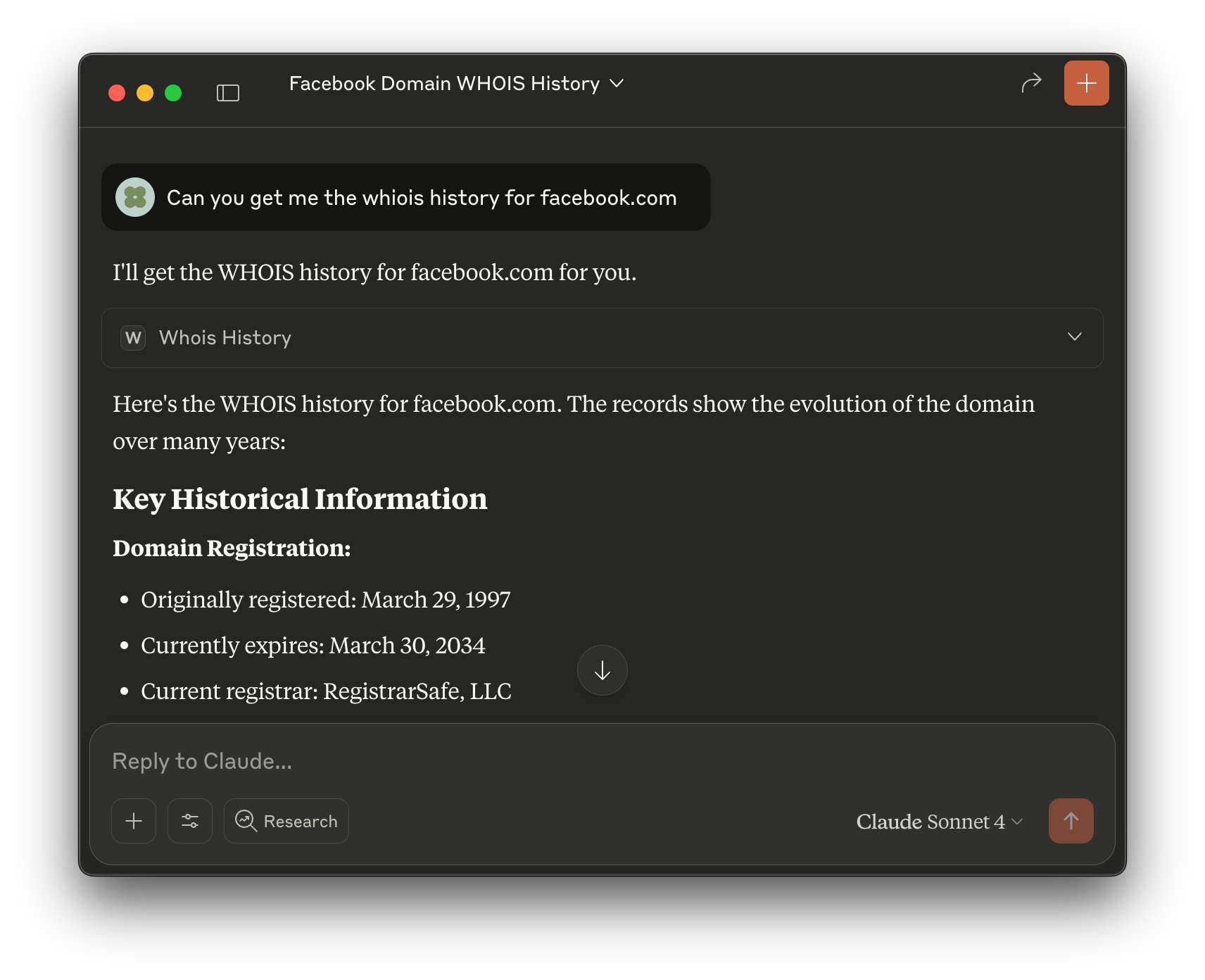
whois_history
Description: Get historical WHOIS records for a domain including past nameservers, contacts, and registrar info. By default it returns only the number of records, for 1 credit instead of 50; set preview_mode to false to get the records. Supports pagination for large result sets.
Arguments
domain_name(string, required) - Domain name to searchlimit(number, optional) - Number of records to return (1-100, default 100) Default: 100next_page_token(string, optional) - IMPORTANT: To fetch the next page, copy the "next_page_token" value from the previous response and pass it here. Do not use "search_after" or any other parameter name - only "next_page_token" is acceptedpreview_mode(boolean, optional) - If true (the default), returns only the number of records, for 1 credit instead of 50. Set to false to return the records Default: trueskip_live_whois_records(boolean, optional) - If true, excludes most recent WHOIS record. Set to true for faster responses; leave false to include it Default: falsesince_date(string, optional) - Return results from this date onwards. Format: YYYY-MM-DDcreated_date_from(string, optional) - Search domains created after this date. Format: YYYY-MM-DDcreated_date_to(string, optional) - Search domains created before this date. Format: YYYY-MM-DDupdated_date_from(string, optional) - Search domains updated after this date. Format: YYYY-MM-DDupdated_date_to(string, optional) - Search domains updated before this date. Format: YYYY-MM-DDexpired_date_from(string, optional) - Search domains expired after this date. Format: YYYY-MM-DDexpired_date_to(string, optional) - Search domains expired before this date. Format: YYYY-MM-DD
Pagination
Responses include a pagination object with:
total_count- Total number of records availablepage_number- Current page number (1-indexed)limit- Number of records in current pagehas_more- Whether more pages are availablenext_page_token- Token to use for the next page (only present ifhas_moreis true). Pass this value as thenext_page_tokenparameter to fetch the next page
A preview (the default) returns total_count with no records, so it never has a next page. Only the records (preview_mode: false) come with a next_page_token, and a call that passes one gets the next page of records whether or not it repeats preview_mode: false.
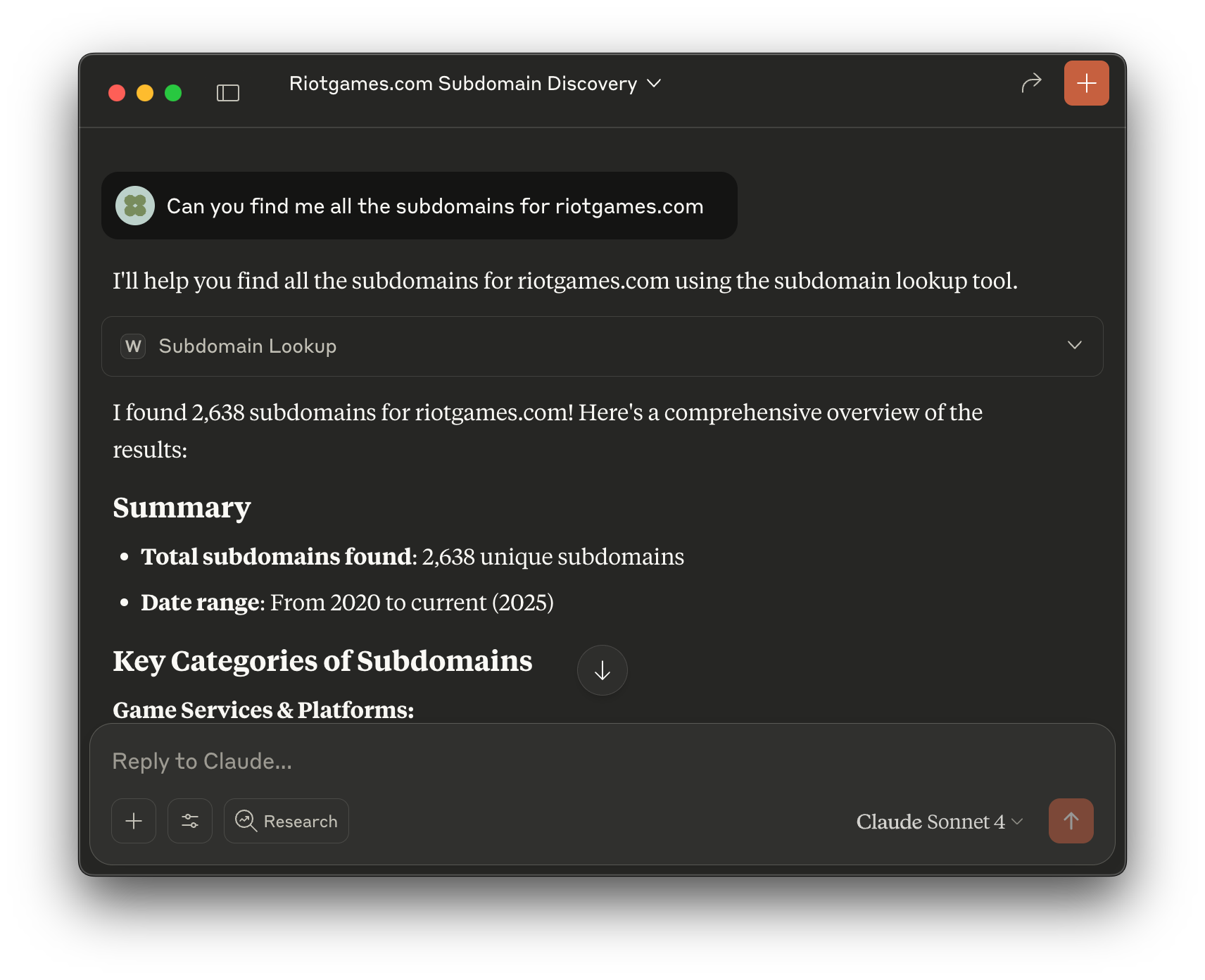
subdomain_lookup
Description: Find all subdomains for a domain with first and last seen timestamps. Supports pagination for large result sets.
Arguments
domain_name(string, required) - Domain name to lookup subdomains forlimit(number, optional) - Number of results to return (1-500). Default 50 while the server's cache is on (the usual setup), 500 when it is off or does not keep the page. Ignored when "next_page_token" is supplied: a continuation keeps the page size the walk started with, so change it only on the first call. A default walk's continuation returns up to 500 rows when the server can no longer hold the pagenext_page_token(string, optional) - IMPORTANT: To fetch the next page, copy the "next_page_token" value from the previous response and pass it here. Do not use "search_after" or any other parameter name - only "next_page_token" is acceptedorder(string, optional) - Row order: recent puts the most recently seen first, when the domain's whole set came in one request of up to 10,000 rows; larger sets stay by name. Ignored with next_page_token: a walk keeps the order it began with Default: "recent" Allowed values: "recent", "name"
Pagination
Responses include a pagination object with:
total_count- Number of subdomains fetched so far, not the size of the whole result set. The upstream API deliberately offers no total (computing one costs roughly 3x per request), so the only way to learn the size of a result set is to page to the endpage_number- Current page number (1-indexed), counting up across upstream page boundarieslimit- Number of subdomains in current pagehas_more- Whether more pages are available. True whenever anext_page_tokenis present, including when the next page comes from a further upstream request rather than from rows already fetchednext_page_token- Token to use for the next page (only present ifhas_moreis true). Pass this value as thenext_page_tokenparameter to fetch the next page
The response also carries:
truncated_at_upstream_cap- Whether the result set may continue beyond what this response contains. Derived from the upstream API's own continuation cursor, so it is exact rather than inferred from a row count: a complete answer of exactly 10000 records is not flagged. It is also set when the response did not let the server prove completeness at all (no cursor, or no readable record list) — in that case nonext_page_tokenis offered, so narrow the query rather than repeating the call
Following next_page_token walks the entire result set, including past the upstream API's cap of 10000 records per request. Each call makes at most one upstream request, so paging deeper is an explicit choice: a Subdomains Lookup request costs 10 Domain Research Suite credits.
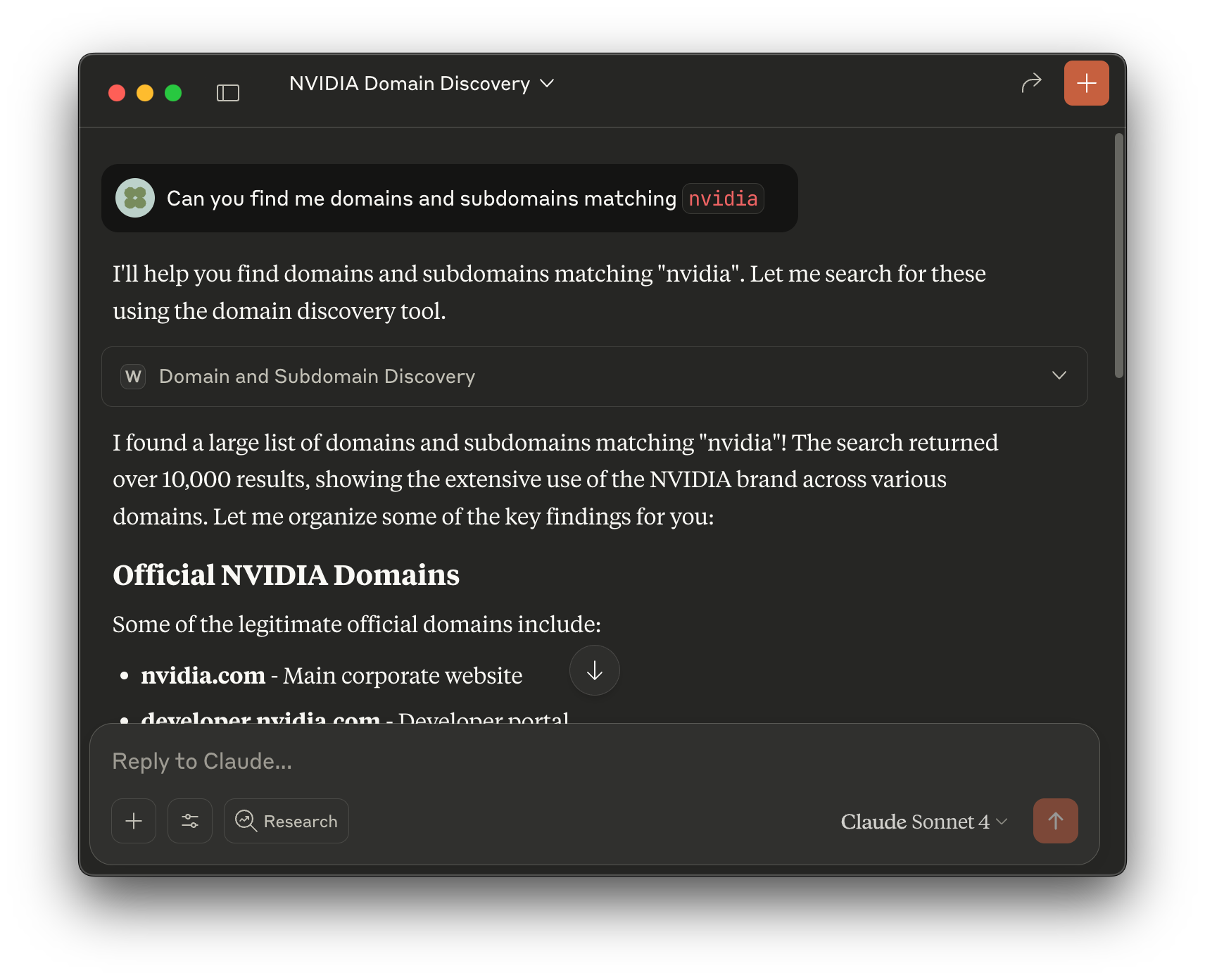
domain_and_subdomain_discovery
Description: Find domains and subdomains matching search terms. Must use wildcards for partial matches otherwise the search will be exact.
Arguments
domain_search_terms(string, optional) - Comma-separated domain search terms (combined with AND logic). Max 4 items. Case insensitive. Must use wildcards for partial matches otherwise the search will be exactdomain_search_terms_exclude(string, optional) - Comma-separated domain search terms to exclude. Max 4 items. Case insensitivesubdomains_search_terms(string, optional) - Comma-separated subdomain search terms (combined with AND logic). Max 4 items. Case insensitivesubdomains_search_terms_exclude(string, optional) - Comma-separated subdomain search terms to exclude. Max 4 items. Case insensitivesince(string, optional) - Search domains/subdomains discovered since this date. Format: YYYY-MM-DDnext_page_token(string, optional) - IMPORTANT: To fetch the next page, copy the "next_page_token" value from the previous response and pass it here, with every other parameter unchanged. Do not use "search_after" or any other parameter name - only "next_page_token" is accepteddomains_only(boolean, optional) - If true, match registered domain names only, without new hosts under them: 1 credit instead of 11. Needs "domain_search_terms"; not allowed with subdomain termslimit(number, optional) - Number of names to return (1-10000). Default 100 while the server's cache is on (the usual setup), the whole upstream page when it is off or does not keep the page. Ignored when "next_page_token" is a token from this tool's own sliced page: that continuation keeps the page size the walk started with Range: 1-10000
Pagination
A response is one page of names. While the server holds the upstream page (its cache is on, the usual setup), the page is 100 names by default; pass limit (up to 10000, the upstream's own page size) for bigger pages. With the cache off, or with WHOISXMLAPI_FULL_ANSWERS=1, the whole upstream page of up to 10000 names comes back. A response carries:
domainsCount- The size of this page, not a total. The upstream API offers no total countfetched_names- Present when the page was sliced: how many names the server fetched from the upstream and holds for this walktruncated_at_upstream_cap- Whether the result set continues beyond this page. Derived from the held names and the upstream's own continuation cursor, so a complete answer of exactly 10000 names is not flaggednext_page_token- Present only when the walk can continue. Pass it back, with every other argument unchanged, to fetch the next page. A token from a sliced page is signed and works only for the same search; a raw upstream cursor is still accepted
Keep calling while truncated_at_upstream_cap is true and a next_page_token is present. If the flag is true but no token is present, the result set may be incomplete and cannot be continued — narrow the search terms or slice by since instead of repeating the call. A continuation answered from names the server already holds (about 30 minutes) costs nothing; when the server no longer holds them, or the call passes a limit that slices a page the server does not hold, the page is fetched again and billed again. Each upstream request is one call to the API, costing 1 Domain Research Suite credit for a domains-only search, 10 for subdomains, 11 for both. A search with domain terms is charged as a search of both, 11 credits, and also lists new hosts under matching domains; pass "domains_only" for registered domains alone, at 1 credit. A search with subdomain terms only is charged 10.
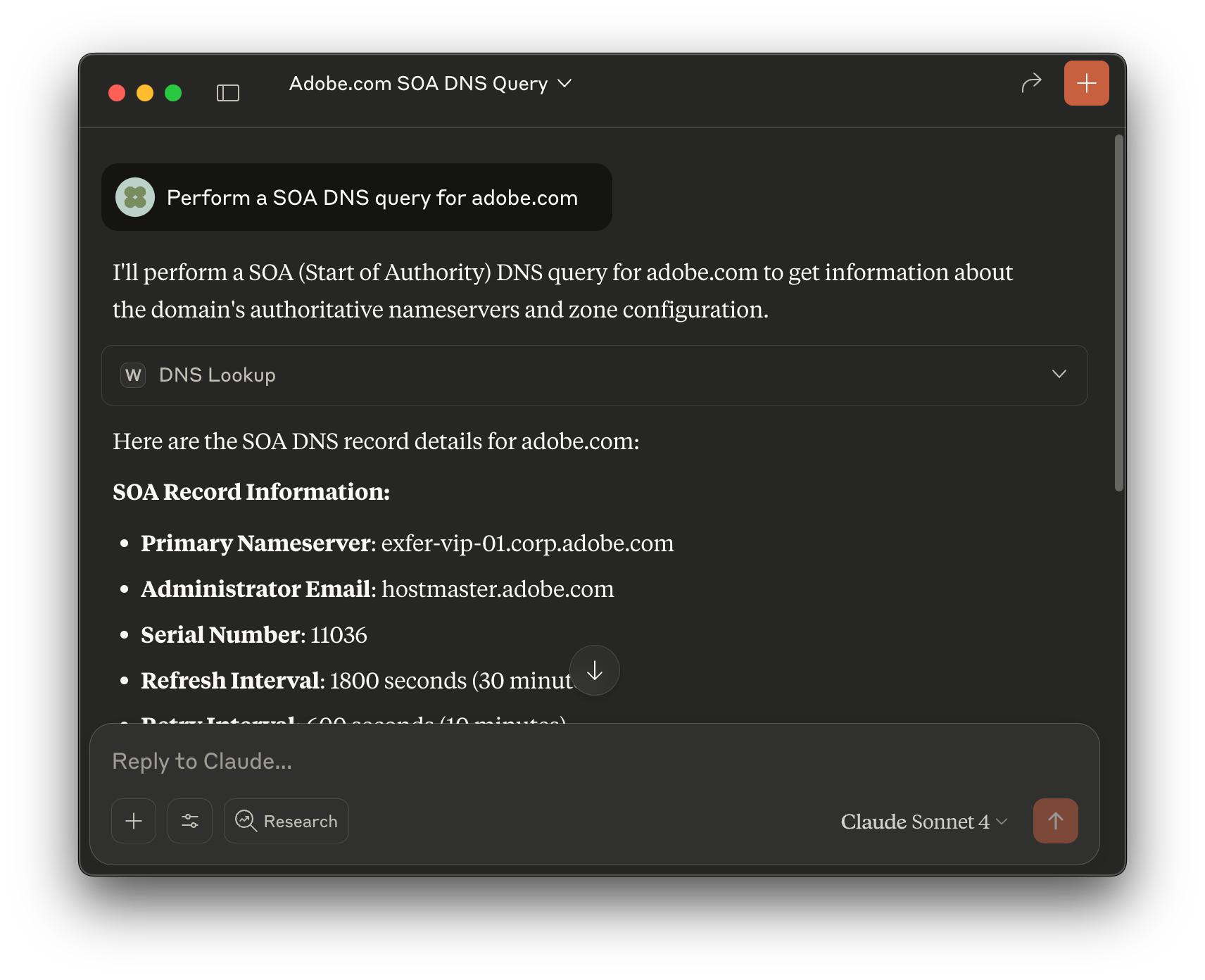
dns_lookup
Description: Perform DNS queries for a domain (A, NS, SOA, MX, etc.).
Arguments
domain_name(string, required) - Domain name to queryquery_type(string, optional) - Comma-separated DNS query types (A, MX, NS, SOA, etc.) or "all" Default: "A"retry_empty(boolean, optional) - If true (default), an answer with no records is asked once more, one more credit; false sends one request
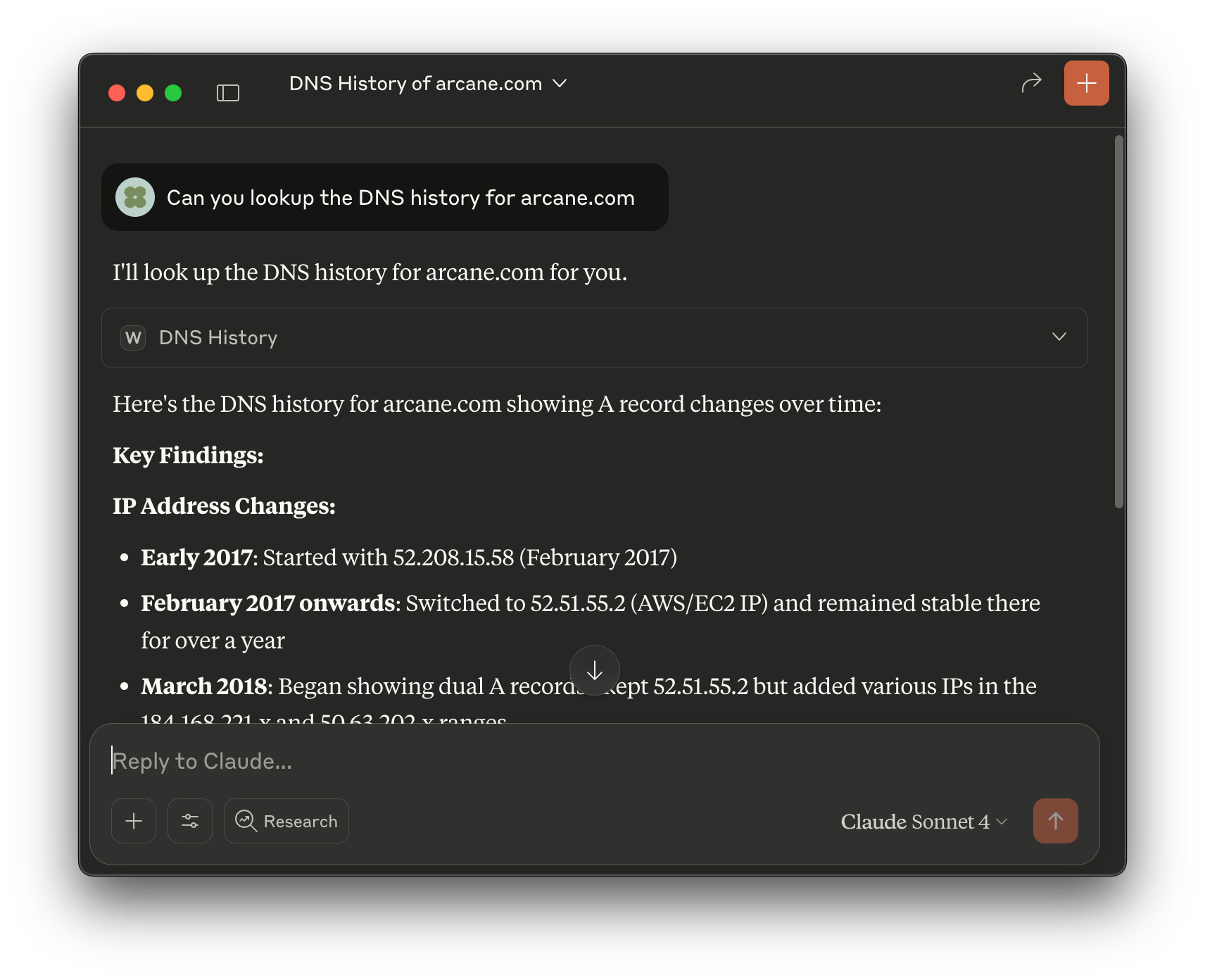
dns_history
Description: Get historical DNS records for a domain (forward) or find domains associated with an IP (reverse).
Arguments
search_type(string, required) - Search type: "forward" or "reverse" Allowed values: "forward", "reverse"record_type(string, required) - DNS record type: "a" or "aaaa". Case insensitive Allowed values: "a", "A", "aaaa", "AAAA"domain_name(string, optional) - Required if "forward" search type. Domain name to searchip_address(string, optional) - Required if "reverse" search type. IP address to search. IPv4 returns A records, IPv6 returns AAAA recordslimit(number, required) - Maximum address rows to return: one per address, so a date with several addresses counts several. With pages, the newest date is cut to its first limit rows if it alone is larger, and paging.newest_record_cut says so. Range: 1-1000. Recommended: 50include_empty(boolean, optional) - If true, keep fields whose value is empty; default falseafter(object, optional) - Position to start after: a previous answer's result.after or paging.next_after, copied as ispages(number, optional) - Requests to make, 5 credits each, reading on past the first 1000 address rows. Range: 1-20. Default 1since(string, optional) - Date YYYY-MM-DD: start at records on or after it, for recent changes; the answer's paging.since repeats it. Not with after. Not a future date
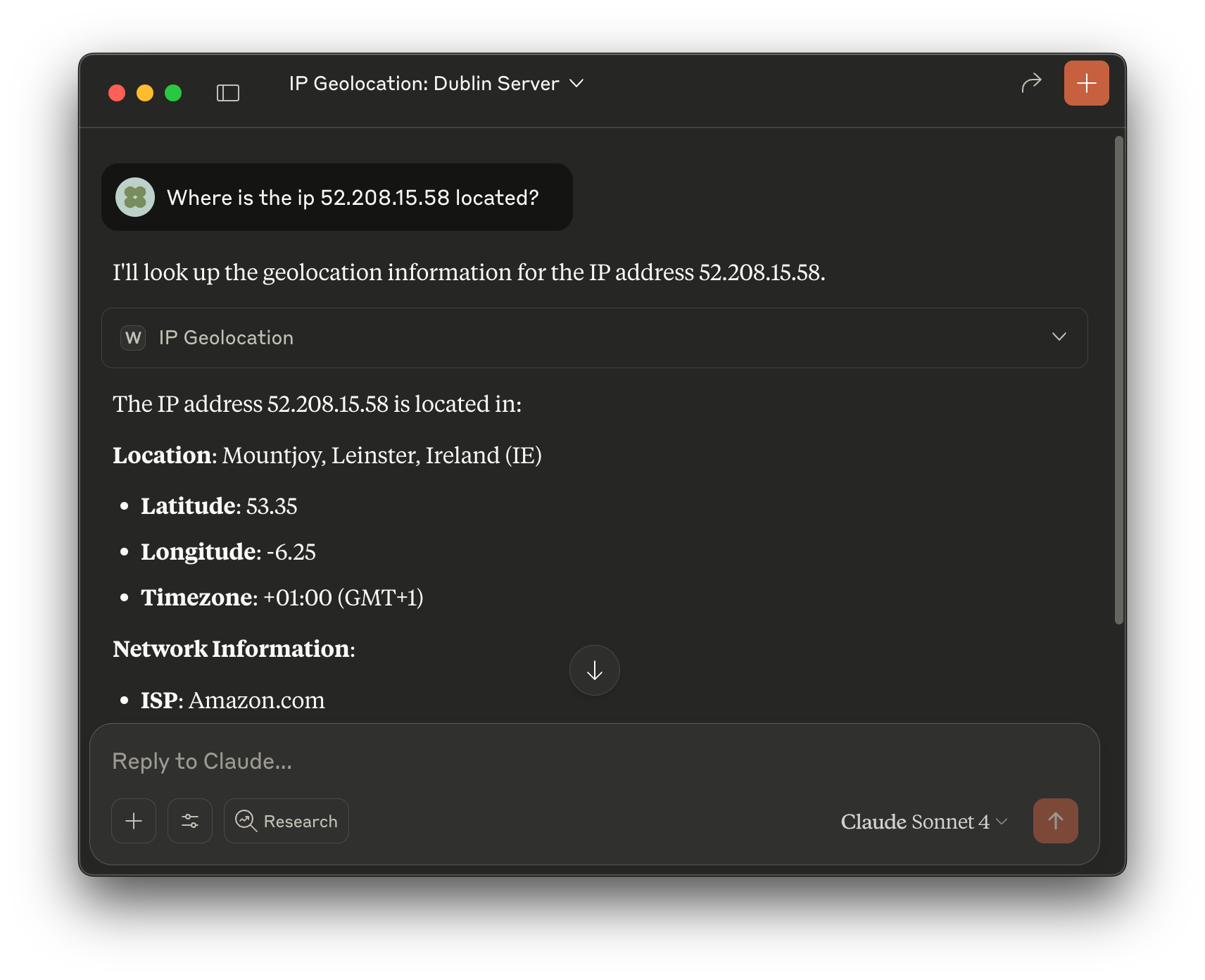
ipgeolocation
Description: Get location data for IP addresses, domains, or email addresses. Uses caller's IP if no address provided.
Arguments
ip_address(string, optional) - IPv4 or IPv6 address. Cannot be used with domain_name or email_addressdomain_name(string, optional) - Domain address. Cannot be used with ip_address or email_addressemail_address(string, optional) - Email address. Cannot be used with ip_address or domain_namereverse_ip(boolean, optional) - If true, returns 5 domains associated with the IP address
Note: Only one of ip_address, domain_name, or email_address can be provided. If none are provided, the caller's IP address will be used.
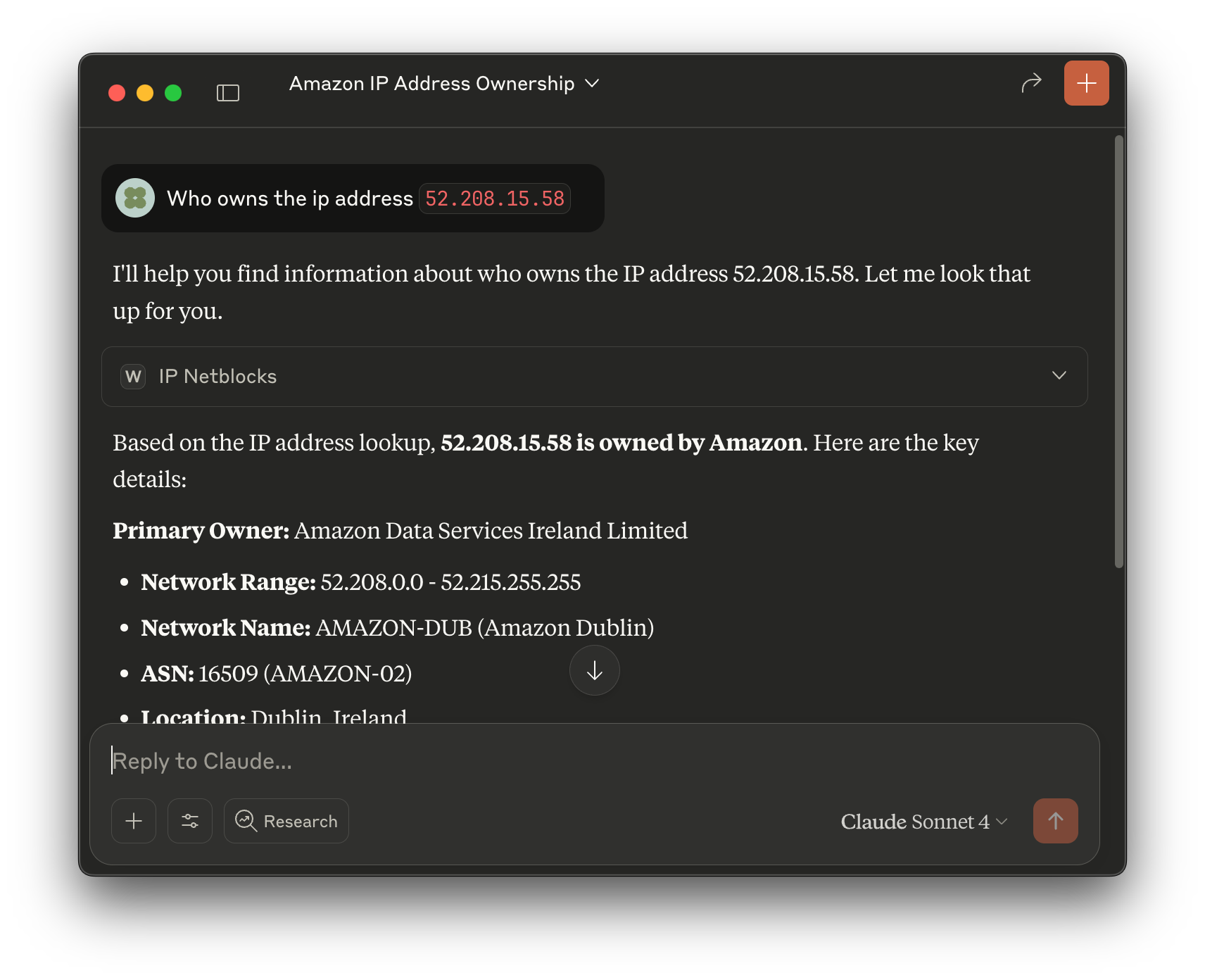
ip_netblocks
Description: Get IP netblock information including IP ranges, ASN, and organization data.
Arguments
ip_address(string, optional) - IPv4 or IPv6 address to searchorganizations(string, optional) - Comma-separated organization search termsasn(string, optional) - ASN number to searchnetmask_value(number, optional) - Netmask value: 0-32 for IPv4, 0-128 for IPv6limit(number, optional) - Maximum records per page. Max: 1000 Default: 100from_needle(string, optional) - Pagination needle from previous page's "inetnum" responseinclude_empty(boolean, optional) - If true, keep fields whose value is empty; default false
Note: At least one of ip_address, organizations, or asn must be provided.
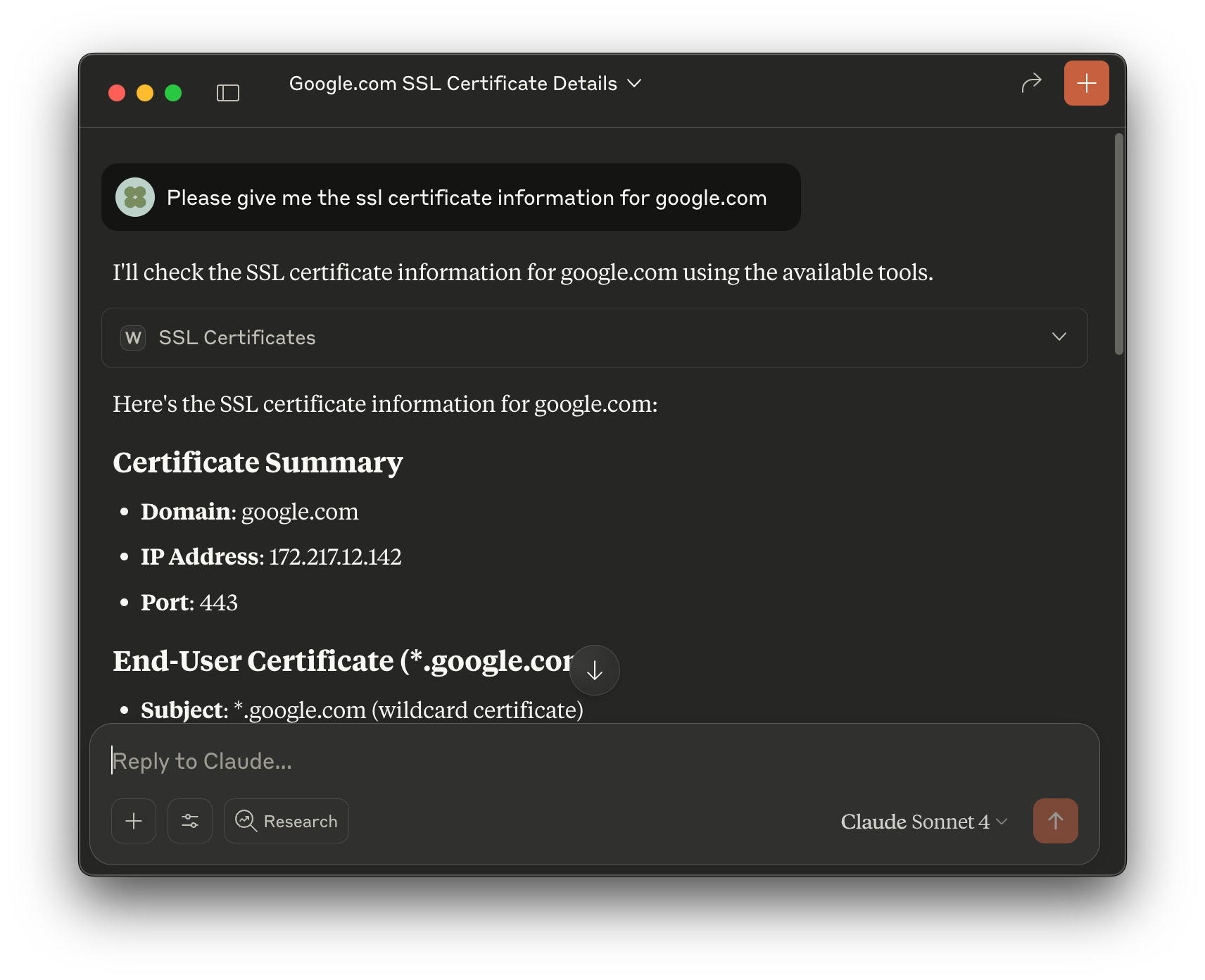
ssl_certificates
Description: Check TLS certificate chain for a domain to analyze certificate validity, expiration, and chain structure
Arguments
domain(string, required) - The domain name to check TLS certificate for (e.g., example.com)include_chain(boolean, optional) - Whether to include the full certificate chain in the response; defaults to false Default: falseuse_fresh_data(boolean, optional) - Whether to get fresh data instead of cached results; defaults to false Default: false
threat_intelligence
Description: Check if IoCs (domains, URLs, IPs, CIDRs, hashes) are associated with malicious activity.
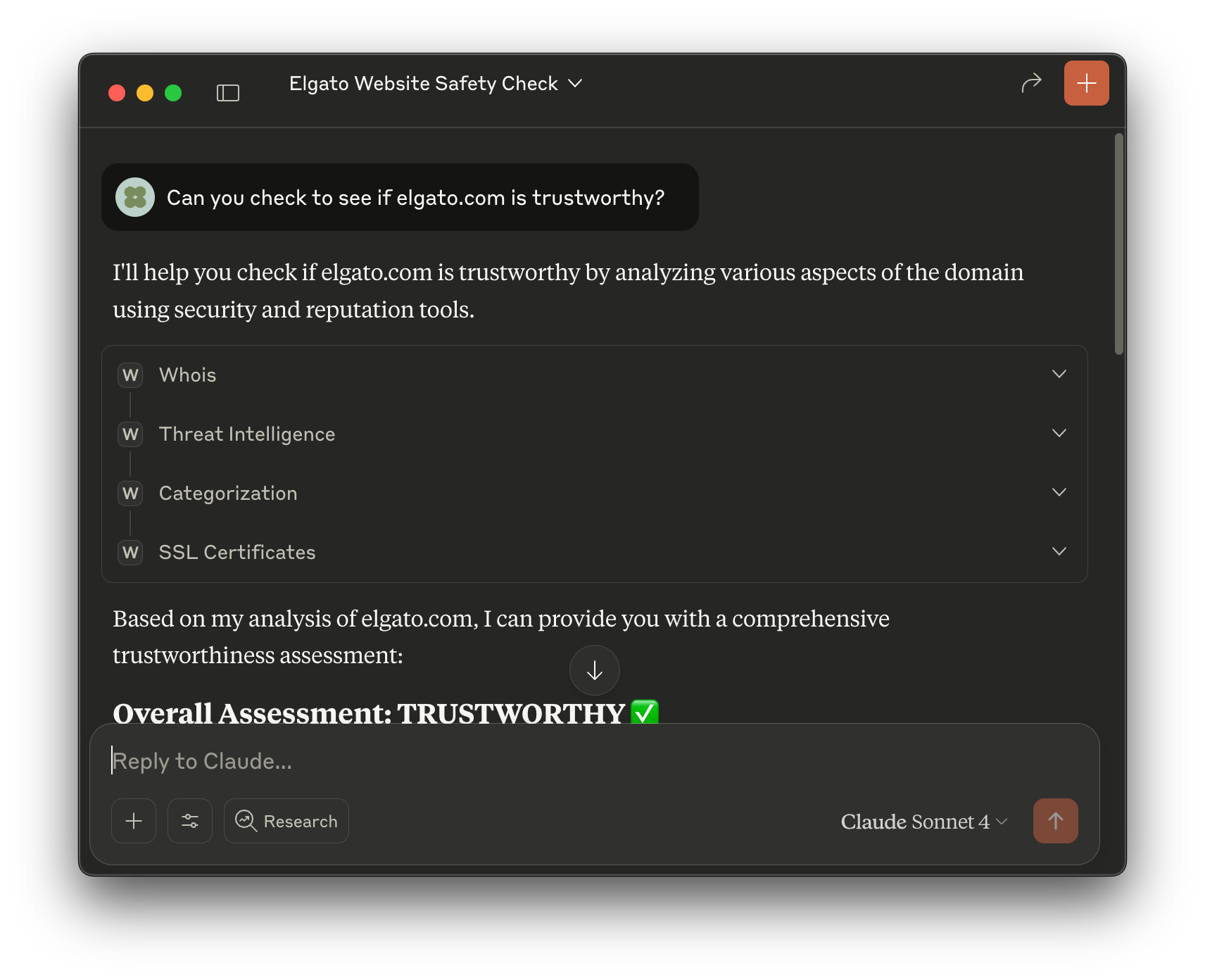
Arguments
search_term(string, required) - IoC to check: domain, URL, IP, CIDR, or hash. Supports wildcards for domains, URLs, IPslimit(number, optional) - Maximum records per page. Max: 10,000. Every 100 records = 1 credit
domain_info
Description: Get comprehensive domain information including registration details, DNS records, and domain availability.
Arguments
domain_name(string, required) - Domain name to query (e.g., example.com)include_empty(boolean, optional) - If true, keep fields whose value is empty; default false
typosquatting
Description: Check whether a domain is part of a known typosquatting group, or expand all domains across all groups the queried domain belongs to. It calls WhoisXML API's Bulk Registration Risk API, formerly the Typosquatting API, and checks one domain per call. Use mode="probe" for a fast triage check (returns inGroup boolean + groupId). Use mode="group" for the heavy follow-up that returns every domain across all groups containing this domain — useful for understanding the full lookalike infrastructure.
Arguments
domain(string, required) - Domain to check (e.g. "gogle.com")mode(string, optional) - Response shape: "probe" for boolean + groupId only (fast); "group" for full list of domains across all groups (heavier, more credits) Default: "probe" Allowed values: "probe", "group"
Note: a "probe" call costs 1 credit and a "group" call costs 5.
Example invocation
{
  "tool": "typosquatting",
  "arguments": {
    "domain": "paypal.com",
    "mode": "probe"
  }
}
Example response (probe mode)
{
  "whoisxmlapi_response": {
    "domain": "paypal.com",
    "inGroup": true,
    "groupId": "group-12345"
  }
}
Example response (group mode)
{
  "whoisxmlapi_response": {
    "domain": "paypal.com",
    "inGroup": true,
    "groupId": "group-12345",
    "groups": [
      {
        "id": "group-12345",
        "domains": [
          { "domain": "paypal.com" },
          { "domain": "paypai.com" },
          { "domain": "paypa1.com" }
        ]
      }
    ]
  }
}
Upstream API docs: https://bulk-registration-risk.whoisxmlapi.com/api/documentation/making-requests
domain_reputation
Description: Score a single domain's trustworthiness on a 0–100 scale by running live infrastructure and configuration checks (certificate validity, mail and name-server setup, malware-database and blackhole lookups, domain age, and more) and return the contributing test results with human-readable warnings. Use this to triage whether a flagged or unfamiliar domain is actually dangerous — for example after typosquatting or brand_alert surfaces a lookalike. Do NOT use it to look up a known-bad verdict from curated threat feeds (use threat_intelligence), to learn what a site claims to be (use categorization), or to fetch raw registration or zone records (those have their own dedicated lookup tools).
Arguments
domain_name(string, required) - Domain name to score (e.g., example.com). An IPv4 address is also accepted upstreammode(string, optional) - Depth of analysis. "fast" runs a select subset of checks (registration status, malware-database check, certificate validity) — cheaper, 1 credit. "full" runs every check (adds mail/name-server/SOA configuration, blackhole, certificate-vulnerability checks, and more) for a more complete score — heavier, 3 credits. Note the score is mode-dependent: "full" surfaces more warnings and so typically returns a LOWER score than "fast" for the same domain Default: "fast" Allowed values: "fast", "full"
domain_profile
Description: Summarizes one domain in one call: age and renewal, blocklist hits, SPF/DMARC policy. Other parts via sections. Default costs at most 7 credits (1 registration-data, 2 blocklist, 4 record-data). Do NOT use this for full records (use whois or dns_lookup).
Arguments
domain(string, required) - The domain to profile, e.g. example.comsections(array of strings, optional) - Parts to include; leave out for the default three Each item is one of: "registration", "threat_feeds", "dns", "reputation", "certificate", "category", "network", "dmarc_record"
infrastructure_pivot
Description: Pivot from one domain to the infrastructure behind it and the other domains that share it, in one call. Reads the domain's name servers, mail servers and hosting, marks big shared providers and parking services as not followed (their other customers are unrelated), and for the rest counts the names on the same servers, with the domains among the first page, a few examples and the arguments to page further. Use this to map a suspicious domain's infrastructure before choosing neighbours to check. Costs at most 15 credits by default, 25 with "follow_addresses", across the products each answer names. Do NOT use this to list every domain on one known server (use reverse_ns, reverse_mx or reverse_ip).
Arguments
domain(string, required) - The domain to start from, e.g. example.comfollow_addresses(boolean, optional) - Also page the domains on busy hosting servers outside big shared networks: at most two pages, 5 credits each Default: falseinclude_names(boolean, optional) - Also list the names on each page fetched, leaving out the domain's own names, up to 300 a page, at no extra credits Default: false
lookalike_triage
Description: Triage the look-alikes of one brand's domain in one call: searches names first seen lately that contain the brand's name, ranks them, groups them into families (campaigns) with each one's pattern and size, sets aside suffixes that answer any name, and checks the top suspects for registration, address records and blocklist hits. Costs 28 to 38 credits by default (18 to 28 with "include_hosts" off), at most 88 with every option (66 with "candidates", which skip the search), across the products each answer names. With "platform_hosts" it also searches new hosts named after the brand on any domain, shared platforms included. Pass "candidates" to check names you already have, with no search. Registrants' personal details are left out of the answer. Do NOT use this to profile one domain (use domain_profile) or to be told of new registrations later (use brand_alert).
Arguments
domain(string, required) - The brand's own domain, e.g. example.com; its name part is searched forcandidates(array of strings, optional) - Up to 10 domains to check instead of searching, such as typo variants or the suspects a timed-out call listedinclude_hosts(boolean, optional) - Also count new hosts under look-alike domains: 10 credits more. False searches registered domains only Default: truemax_suspects(number, optional) - How many top suspects to check, 1 to 10 Default: 5 Range: 1-10platform_hosts(boolean, optional) - Also search new hosts named after the brand on any domain, shared platforms included: 10 credits more. Listed, never checked Default: falsesections(array of strings, optional) - What to check for each suspect; leave out for the first three. certificate and bulk_group cost 1 credit more each Each item is one of: "registration", "dns", "threat_feeds", "certificate", "bulk_group"since(string, optional) - Only names first seen on or after this date, YYYY-MM-DD. Default 7 days back
website_screenshot
Description: Capture a screenshot of a web page for a URL and return it as a native image content block, plus a small JSON summary with its MIME type, decoded byte size and chosen type. Choose the output format with the type parameter: "png" (default) or "jpg" for raster images, or "pdf" to render the page as a PDF. Optionally set the viewport width and height in pixels, and enable full-page capture to grab the entire scrollable page instead of just the visible viewport. The image data is in the image block only, so a consumer can embed or save it without a second request. Use this to obtain visual evidence of how a site actually looks — for example to document a suspicious, phishing, or typosquatting page surfaced by another tool. Do NOT use it to read a page's text, fetch DNS or WHOIS records, or classify the site, since those have their own tools.
Arguments
url(string, required) - The fully-qualified URL of the page to capture (e.g., https://example.com)type(string, optional) - Output format of the screenshot: "png" (default) or "jpg" for raster images, or "pdf" for a PDF rendering Default: "png" Allowed values: "png", "jpg", "pdf"width(number, optional) - Viewport width in pixels. Optional; the API uses a default when omittedheight(number, optional) - Viewport height in pixels. Optional; the API uses a default when omittedfull_page(boolean, optional) - If true, capture the full scrollable page rather than just the viewport
Note: The server refuses to capture URLs that resolve to internal or private address space (loopback, private ranges, link-local, CGNAT) as an SSRF guard.
vpn_proxy_detection
Description: Check whether one IP address belongs to a known VPN, proxy (including residential and open proxies), Tor exit, relay, hosting or CDN network, using the WhoisXML VPN & Proxy Detection API. Every plan returns classification (for example vpn, proxy, tor, hosting, cdn or unknown), risk_score (0-100), boolean is_* flags, the ASN and its abuse score, and reasons codes explaining the verdict. Other fields depend on the plan and read null on lower plans: provider and the registered netblock owner need Starter or higher; confidence, first_seen / last_seen and residential-proxy network names need Pro or higher. A residential-proxy network is named only where the exit has been attributed to it. Each successful lookup consumes 1 VPN & Proxy Detection API credit.
Arguments
ip_address(string, required) - IP address to classify (e.g., 185.220.101.1). IPv4 recommended; see the tool description for IPv6
Notes:
- Detection data is IPv4-first. IPv6 addresses are accepted, but most currently return
classification: "unknown". - Private and other reserved addresses (RFC 1918, loopback, multicast, link-local, TEST-NET) are rejected with an
invalid_ip_reservederror and are not charged. Carrier-grade NAT space (CGNAT, RFC 6598,100.64.0.0/10) is not rejected: it is looked up and charged like any other address. - Some response fields depend on your VPN & Proxy Detection plan. Those keys stay present but read
nullorfalsebelow the plan that unlocks them, so check your plan rather than field presence.
domain_availability
Description: Check whether one domain name is already registered or free to register, using the WhoisXML Domain Availability API. The API's answer comes back unchanged under whoisxmlapi_response: its DomainInfo object holds domainAvailability (AVAILABLE, UNAVAILABLE or UNDETERMINED) and domainName, the domain checked. UNDETERMINED means the API could not reliably decide, for example after a transient error or for a TLD it does not support; the server passes it on as it comes. Each lookup consumes 1 credit.
Arguments
domain_name(string, required) - Domain name to check (e.g., example.com)credits(string, optional) - Which credit balance the lookup is billed to. The default uses the Domain Availability balance; the other value uses the separate registration-data balance Default: "DA" Allowed values: "DA", "WHOIS"mode(string, optional) - Depth of the check. The default (when omitted) is the fastest check; the other value is slower and more accurate Allowed values: "DNS_ONLY", "DNS_AND_WHOIS"
Notes:
- The name is trimmed, lower-cased and stripped of one trailing dot before the lookup. A name that is empty after that is rejected before any call and costs nothing.
modeisDNS_ONLY(the API's default, the fastest check) orDNS_AND_WHOIS(slower and more accurate).creditspicks the balance a lookup is billed to:DA, the Domain Availability API balance (this server's default), orWHOIS, the WHOIS API balance. The API itself bills the WHOIS balance when the parameter is left out, so the server always sends it.- An
AVAILABLEanswer is the state the API saw at the time of the check. It does not reserve the name, and the tool does not say who owns a registered domain.
account_balance
Description: Show how many credits the account has left on each WhoisXML API product, and which of these tools spend each product's credits. The call itself spends no credits. Use it before a large or bulk job, or after a call fails for lack of credits.
Arguments
all_products(boolean, optional) - If true, list every product the account holds, including those with no credits that no tool on this server uses; default false
This tool takes no arguments.
Response
Returns products, one entry per product on the account, sorted by product_id:
product_id- WhoisXML's product IDproduct- Product name, for exampleWHOIS APIcredits- Credits left; absent when the product has no credit limitunlimited-truewhen the product has no credit limittools- The tools that spend the product's credits, when there are any. A server started with--disabled-toolsmay not serve all of them
The response lists credits only: no prices, plans or billing details.
tool_search
Description: Search for available tools by keyword. Uses BM25 ranking to find the most relevant tools based on their names, descriptions, and parameters. This tool is automatically enabled when the server is started with --defer-loading and does not consume API credits.
Arguments
query(string, required) - Search query to match against tool names, titles, and descriptionsmax_results(number, optional) - Maximum number of results to return. Defaults to 5
Response
Returns a JSON object with:
query- The original search queryresults- Array of matching tools, each containing:name- Tool namedescription- Tool descriptionparameters- Array of parameter definitions with name, description, type, and required status
total_available_tools- Total number of tools registered on the server
Deferred Loading
When the server is started with --defer-loading, all API tools are marked with defer_loading: true. Compatible MCP clients will only load tool_search into context initially, and use it to discover other tools on demand. See Configuration for details.
Bulk Tools
The server exposes 7 bulk variants and 2 polling helpers. All bulk tools return a uniform envelope:
{
  "whoisxmlapi_response": {
    "status": "completed" | "running" | "error",
    "job_id": "<opaque>",
    "total": N,
    "succeeded": N,
    "failed": N,
    "results": [
      { "input": "...", "ok": true, "data": { /* upstream record */ } },
      { "input": "...", "ok": false, "error": { "code": "...", "message": "..." } }
    ]
  }
}
Sync vs async: the server waits up to 20 seconds before returning. If a native bulk job is still in progress, it returns status: "running" and an opaque job_id. Use bulk_job_status to check progress and bulk_job_results to fetch the final results.
Emulated bulk (DNS, subdomain, IP geo, domain availability) is sync-only; these tools fan out single-input calls concurrently and are capped at 200 inputs per call. Exceeding the cap returns code: "EMULATED_BULK_CAP_EXCEEDED" rather than silently truncating.
Cost transparency: bulk variants do NOT save credits. 100 single calls and 1 bulk-of-100 cost the same. Bulk's value is latency, atomicity, and rate-limit consolidation.
bulk_whois
Description: Run WHOIS lookups for up to 10,000 domains in a single call. Uses WhoisXML's native Bulk WHOIS API. Each domain consumes 1 credit. Returns inline if the job completes within 20 seconds; otherwise returns status: "running" with a job_id for polling via bulk_job_status / bulk_job_results.
Arguments
domains(array of strings, required) - Domain names to look up (1 credit per domain, max 10000 per call)confirm(boolean, optional) - Pass true to run a call estimated at over 100 credits, once the user has agreed to that cost
Response
Returns the uniform bulk envelope with per-domain WHOIS records in results[].data.
bulk_dns_lookup
Description: Run DNS lookups for up to 200 domains in a single call. Emulated bulk — the server fans out single DNS lookups concurrently. Each input consumes 1 credit. Always returns synchronously (no async job).
Arguments
domain_names(array of strings, required) - Domain names to look up (1 credit per domain, max 200 per call)query_type(string, optional) - Comma-separated DNS query types (A, MX, NS, SOA, etc.) or "all". Applied uniformly to all inputs Default: "A"confirm(boolean, optional) - Pass true to run a call estimated at over 100 credits, once the user has agreed to that cost
Response
Returns the uniform bulk envelope with per-domain DNS records in results[].data.
bulk_ip_geolocation
Description: Run IP geolocation lookups for up to 200 IPs in a single call. Emulated bulk: the server fans out single-IP lookups concurrently. Each input consumes 1 credit. For larger jobs, WhoisXML's Bulk IP Geolocation API (not a tool on this server) runs asynchronous JSON jobs of up to 100,000 IPs.
Arguments
ip_addresses(array of strings, required) - IP addresses to look up (1 credit per IP, max 200 per call)confirm(boolean, optional) - Pass true to run a call estimated at over 100 credits, once the user has agreed to that cost
Response
Returns the uniform bulk envelope with per-IP geolocation records in results[].data.
bulk_email_verification
Description: Verify up to 10,000 email addresses in a single call. Uses WhoisXML's native Bulk Email Verification API. Each email consumes 1 credit. Returns inline if the job completes within 20 seconds; otherwise returns status: "running" with a job_id. Per-row classification: ok / invalid (INVALID_EMAIL) / unknown (UNKNOWN) / failed (VERIFICATION_FAILED).
Arguments
emails(array of strings, required) - Email addresses to verify (1 credit per email, max 10000 per call)confirm(boolean, optional) - Pass true to run a call estimated at over 100 credits, once the user has agreed to that cost
Response
Returns the uniform bulk envelope with per-email verification records in results[].data.
bulk_subdomain_lookup
Description: Run subdomain lookups for up to 200 domains in a single call. Emulated bulk — the server fans out single subdomain lookups concurrently, reusing the in-memory cache of subdomain_lookup so recently-fetched domains are free to re-query.
Arguments
domain_names(array of strings, required) - Domain names to look up (10 Domain Research Suite credits per uncached domain, max 200 per call)confirm(boolean, optional) - Pass true to run a call estimated at over 100 credits, once the user has agreed to that cost
Response
Returns the uniform bulk envelope with per-domain subdomain lists in results[].data.
bulk_vpn_proxy_detection
Description: Check up to 100 IP addresses in one call for VPN, proxy, Tor exit, relay, hosting or CDN membership. Uses the VPN & Proxy Detection API's native batch endpoint, so it always returns synchronously (no async job). Duplicate inputs are looked up once. Each IP successfully looked up consumes 1 VPN & Proxy Detection API credit; rejected rows are not charged. Batch lookup requires a Starter or higher VPN & Proxy Detection plan, and each row follows the same plan rules as vpn_proxy_detection: confidence, first_seen / last_seen and residential-proxy network names need Pro or higher and read null on lower plans.
Arguments
ip_addresses(array of strings, required) - IP addresses to classify (max 100 per call; 1 credit per IP successfully looked up)
Response
Returns the uniform bulk envelope. Each successful row's results[].data carries the same fields as vpn_proxy_detection. A row the API rejects comes back with ok: false and an error code such as INVALID_IP_RESERVED or INVALID_IP_FORMAT. The IPv4-first note on vpn_proxy_detection applies here too.
bulk_domain_availability
Description: Check up to 200 domain names in one call for registration availability. Emulated bulk: the server runs single Domain Availability lookups concurrently, always in the API's fast default mode; for the slower, more accurate check of a few domains, use domain_availability. Each entry is trimmed, lower-cased and stripped of one trailing dot; blank entries are dropped and a domain sent twice is looked up once. Each lookup consumes 1 credit, billed as credits picks, as for domain_availability. The limit of 200 counts every entry sent, blanks and duplicates included.
Arguments
domain_names(array of strings, required) - Domain names to check (1 credit per domain, max 200 entries per call). Duplicates are looked up onceconfirm(boolean, optional) - Pass true to run a call estimated at over 100 credits, once the user has agreed to that costcredits(string, optional) - Which credit balance the lookups are billed to. Defaults to DA (Domain Availability credits) Allowed values: "DA", "WHOIS"
Response
Returns the uniform bulk envelope. Each successful row's results[].data is the API's DomainInfo object for that domain, unchanged: the object domain_availability returns under whoisxmlapi_response.DomainInfo; UNDETERMINED is passed on as it comes. A row whose lookup fails comes back with ok: false and its own error, and the other rows still run, unless that error is terminal (for example an exhausted monthly quota): the rows still running or waiting then come back as ABORTED_BY_TERMINAL.
bulk_job_status
Description: Check the progress of an in-flight native bulk job (created by bulk_whois or bulk_email_verification). Returns status: "running" with progress counters while the job is in progress, or status: "completed" when done. Tenant-safe: rejects probes for jobs belonging to a different API token (code: "TENANT_MISMATCH").
Arguments
job_id(string, required) - Opaque job identifier returned by a bulk_* tool when status=running
Response
Returns the uniform bulk envelope with status, total, succeeded, and failed counters. results is empty while the job is still running.
bulk_job_results
Description: Fetch the full per-input results for a completed native bulk job. If the job is still in progress, returns status: "running" — the caller should retry after a short delay. Tenant-safe: rejects cross-tenant probes (code: "TENANT_MISMATCH").
Arguments
job_id(string, required) - Opaque job identifier returned by a bulk_* tool when status=running
Response
Returns the uniform bulk envelope with the full results array populated once the job is complete.
Authentication
All API tools require proper authentication via the WhoisXMLAPI. The tool_search tool (when enabled via --defer-loading) does not require authentication as it only searches tool definitions. The server must be configured with valid API credentials for the WhoisXMLAPI service.
Response Format
All tools return responses in JSON format. The structure of the response depends on the specific tool and the data returned by the WhoisXMLAPI.
Rate Limits and Credits
- A tool call can consume API credits based on WhoisXMLAPI pricing; What each tool costs gives each tool's cost
- Rate limits are enforced by the WhoisXMLAPI service
- Failed requests typically don't consume credits
Spend Cap
The server does not run a call it estimates will spend more than 100 credits unless the call passes confirm: true. It answers with an error result, with _meta.errorCause set to bad_arguments, that gives the estimate (for example "It could spend up to 5000 credits (1 for each of the 5000 entries in domains)") and asks the model to check with the user. Nothing is sent to WhoisXML API. Once the user agrees, the model repeats the same call with confirm: true added.
- Only the tools that can go over the cap take
confirm:bulk_whoisandbulk_email_verification(up to 10,000 credits a call),bulk_subdomain_lookup(up to 2,000),brand_alert(300 for a purchase withwith_typos: true), andbulk_dns_lookup,bulk_ip_geolocationandbulk_domain_availability(up to 200).bulk_vpn_proxy_detectiontakes at most 100 distinct IPs at 1 credit each, so it never goes over the cap. - A list longer than its tool accepts gets the tool's own error, not the cap's, since the tool rejects it before any upstream request.
- Single-input tools, except for a
brand_alertpurchase with typos, and any call estimated at 100 credits or fewer, run as before. - The estimate counts every input at the rate its tool's arguments give above, so it can be higher than the final charge: a domain still in the
bulk_subdomain_lookupcache costs nothing, and so does a blank or repeated entry inbulk_domain_availability. - The cap applies in stdio and hosted mode alike.
Best Practices
- Start broad: Use basic tools like
whoisanddns_lookupfirst - Follow leads: Use results to inform subsequent queries
- Combine tools: Use multiple tools for comprehensive analysis
- Check history: Use historical tools to understand changes over time
- Verify results: Cross-reference data from multiple tools
Error Handling
Common error scenarios:
- Invalid input: Malformed domains or IP addresses
- Rate limiting: Too many requests in a short timeframe
- Insufficient credits: Account lacks sufficient API credits
- Network issues: Temporary connectivity problems
The server handles these gracefully and provides clear error messages to help diagnose issues.
Disabling Tools
If you don't need all 40 tools, you can disable specific ones to reduce functionality or improve startup performance. This is useful for:
- Reducing API surface: Limit available tools for security
- Performance optimization: Faster startup with fewer tools
- Specialized use cases: Only enable tools relevant to your workflow
You can disable tools using environment variables or command-line flags:
# Disable security-related tools
export WHOISXMLAPI_DISABLED_TOOLS="threat_intelligence,reverse_whois"

# Disable historical analysis tools
export WHOISXMLAPI_DISABLED_TOOLS="whois_history,dns_history"
See Configuration for complete documentation and examples.